Overcome caregiver sibling conflict with effective communication and teamwork. Learn practical tips to foster collaboration and reduce stress.
Mike
Helping-mom

Few caregiving situations create more stress than conflict between siblings. One person may feel overwhelmed and unsupported while another feels criticized or left out. When aging parents need help, old family dynamics often reappear in surprising ways. The good news is that sibling conflict is common, understandable, and often manageable with the right communication and planning.
Sibling conflict over caregiving often stems from unequal effort, miscommunication, and unclear roles. Establishing shared tracking systems and clear task domains helps reduce disputes and promotes teamwork among siblings. Involving outside professionals can resolve persistent conflicts rooted in old family dynamics and foster long-term cooperation.
Caregiver sibling conflict is the tension and disagreements that arise among adult siblings sharing the responsibility of caring for aging parents, most often fueled by unequal effort, poor communication, and unclear roles. The Family Caregiver Alliance recognizes family conflict as one of the top three caregiver stressors alongside physical demands and financial strain.
What makes this kind of conflict so hard is that it sits at the intersection of love, exhaustion, and old family history. The good news is that most of it is preventable. With the right systems and honest conversations, siblings can move from resentment to real teamwork.
The four most common sources of sibling fights over parent care are unequal effort, disagreements about a parent's health status, financial disputes, and unilateral decision-making. Each one is worth understanding on its own terms.
One sibling, usually the one who lives closest, absorbs the daily tasks. Primary caregivers handle up to 80% of daily tasks and expenses. Siblings who live farther away often underestimate this load, not out of selfishness, but because they simply cannot see it.
A sibling who visits once a month may not recognize how much has changed. The gap in perception creates real friction, especially around decisions like whether a parent needs more help at home. Read our guides on early signs of dementia and memory changes in aging parents to help align everyone's understanding.
Who pays for what? Should a sibling who contributes more time be compensated? These questions rarely have easy answers, and avoiding them only makes things worse. See our guide to managing care costs.
When one sibling makes a medical or financial call without consulting the others, even with good intentions, it breeds resentment. Old family roles resurface fast under caregiving stress.
Pro Tip: When a sibling seems disengaged, ask what they can realistically offer before assuming they don't care. Constraints like work schedules or distance are real, and naming them openly reduces blame.
Moving from "who does more" conflicts to designing transparent shared systems is the most effective shift siblings can make. A shared system gives everyone access to the same facts, which removes the guesswork that feeds accusations.
The core elements of a shared system are simple. Siblings need a common place to track medications, doctor's appointments, care expenses, and any changes in the parent's condition. This does not have to be complicated. A shared Google Doc, a group text thread with a consistent format, or a dedicated app all work — Helping-mom offers a free medication tracker and emergency information organizer to get you started. The point is that no one sibling holds all the information.
Date, medication name, dose, and who administered it
Date, provider, outcome, and follow-up needed
What was spent, by whom, and for what purpose
Brief weekly observations about mood, mobility, or behavior
Shared tracking systems for medications, doctor's notes, and finances give siblings a common factual baseline. That baseline matters because most arguments are not really about facts. They are about different interpretations of facts no one has agreed on.
Regular communication rhythms matter just as much as the tools. A monthly call with a short agenda keeps everyone current without requiring daily updates. Try our family meeting guide for a practical framework. Regular decision rhythms like monthly calls and shared agendas help siblings stay coordinated and reduce conflict escalation.

| Communication Tool | Best Use |
|---|---|
| Shared document or spreadsheet | Ongoing medication, expense, and appointment logs |
| Group video call (monthly) | Updates, decisions, and checking in on the primary caregiver |
| Messaging app thread | Quick daily or weekly updates and urgent alerts |
| Written decision log | Recording what was decided, by whom, and when |
Pro Tip: Frame caregiving requests as building a shared system, not as asking for help. "Can we set up a shared log together?" lands very differently than "You never know what's going on."
Assigning specific domains of care to each sibling based on their real-life constraints shifts emotional blame to concrete, manageable tasks. This is one of the most practical things a sibling group can do.
Appointments, medications, doctor communication
Bills, insurance, cost-sharing, budgeting
Groceries, maintenance, safety, daily errands
Companionship, check-ins, morale, family connections
List every caregiving task and sort it into medical, financial, home, or emotional support.
Assign ownership based on what each sibling can realistically commit to, not what seems fair in the abstract.
Agree in advance on which decisions require group input and which the assigned sibling can make independently. See our Power of Attorney guide for help with legal decision-making authority.
Revisit assignments every few months, because circumstances change.
A simple one-page summary prevents "that's not what we agreed" conversations later.
| Approach | What it looks like in practice |
|---|---|
| No defined roles | Every decision triggers a group debate; primary caregiver burns out |
| Defined domains with clear ownership | Each sibling knows their lane; decisions happen faster with less friction |
This is one of the most searched — and most painful — questions in family caregiving. When one sibling simply will not engage, the emotional and practical burden falls even harder on those who do. While you cannot force participation, you can protect yourself and create a sustainable path forward.
The key is shifting your focus from what you cannot control to what you can. Here's what that looks like in practice:
Accepting this reality, however frustrating, frees you to focus energy on what you can actually change. Trying to force involvement usually deepens resentment on both sides.
You can control your own boundaries, your communication style, and the systems you build. Pour your energy there instead of into resentment.
General requests ("Can you help more?") rarely work. Instead, ask: "Can you handle Mom's insurance calls twice a month?" Specific tasks with clear boundaries are harder to ignore.
When a sibling refuses to help, your risk of burnout skyrockets. Prioritize your own well-being — see our caregiver well-being resources for support that goes beyond logistics.
Some siblings contribute emotionally, some financially, and some not at all. While it's deeply unfair when one sibling carries the load, accepting reality — not as approval, but as clarity — helps you plan realistically. Build your care system assuming the current level of involvement, and if a sibling steps up later, that's a bonus, not a requirement.
Pro Tip: Keep the door open without holding it open. A simple "We'd love to have your input when you're ready" sends a clear message without burning the bridge. Then return your energy to what you can control.
The local vs. long-distance sibling dynamic is one of the most common sources of caregiver sibling conflict — and one of the most solvable. The tension usually flows from a fundamental mismatch: the local sibling sees the daily reality up close, while the long-distance sibling sees only occasional snapshots.
Local siblings often handle the daily, invisible tasks that accumulate into an enormous workload:
Long-distance siblings can own entire domains of care that don't require physical presence:
The most successful sibling teams explicitly acknowledge that both roles matter. The local sibling's daily presence is irreplaceable — and so is the long-distance sibling's ability to manage the logistical and financial scaffolding that keeps care sustainable. Use long-distance caregiving tips and shared digital tools to close the information gap, and schedule regular video calls where the long-distance sibling can see how the parent is doing — not just hear secondhand reports.
Pro Tip: Long-distance siblings: never say "Let me know if you need anything." It puts the burden back on the overwhelmed local sibling. Instead, say "I'm going to take over the insurance calls starting this week." Specific ownership beats open-ended offers every time.
Old family patterns are the hidden engine behind many caregiving disputes. The sibling who was always overlooked feels overlooked again. The one who was always expected to step up resents carrying the load. Caregiving triggers resurfacing childhood roles and perceptions of fairness that hinder teamwork without deliberate intervention.
Recognizing this dynamic is the first step. When a conversation about a medication schedule turns into an argument about who was always the favorite, that is a signal that something deeper is at play. Naming it calmly, without accusation, can defuse it.
Agree to recognize when old roles are showing up and set them aside for caregiving conversations.
A therapist or mediator can help when arguments keep cycling. Teletherapy options like BetterHelp or Talkspace make this accessible across cities.
Carve out time to connect outside of caregiving tasks. A phone call not about your parent's care can preserve the relationship.
"You never helped when we were kids" does not belong in a discussion about who drives Mom to her next appointment.
Caregiving often feels transactional under strain, so intentionally reconnecting as siblings is what keeps the relationship intact. The logistics of care are temporary. The sibling relationship is not.
Pro Tip: If a sibling conversation keeps escalating, suggest a 48-hour pause before continuing. Decisions made in the heat of old grievances rarely hold up.
Sustained cooperation requires structure, not just goodwill. Goodwill fades under stress. Structure holds.
The invisible coordinator trap leads to burnout when one sibling absorbs daily tasks and emotional labor without recognition. Preventing this requires the whole sibling group to actively acknowledge what the primary caregiver is doing. A simple "I see how much you're managing" goes further than most siblings realize.
Hold a family meeting every four to six weeks with a written agenda. Rotate who runs it.
Use a shared digital platform, such as Google Workspace or a dedicated care coordination app, to keep records current.
Acknowledge the primary caregiver's contributions explicitly and often.
Discuss financial contributions openly. If one sibling cannot contribute time, can they contribute money? If not, say so directly rather than going silent.
Agree in advance on a process for decisions that cannot wait for group consensus. Designate one sibling as the tie-breaker for urgent medical situations.
Designing systems that function even when one sibling is less engaged is a pragmatic approach. Not every sibling will participate equally, and building a system that accounts for that prevents the whole structure from collapsing when someone goes quiet.
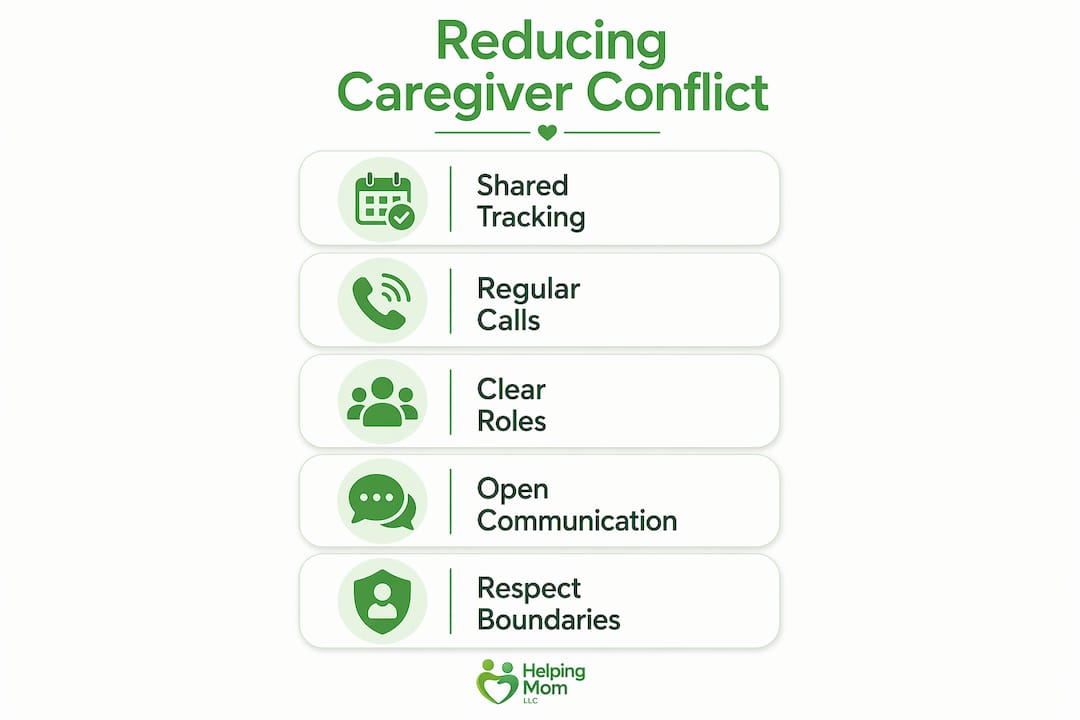
A shared system with equal access to information, defined roles, and transparent decision-making is the most effective way to reduce sibling caregiving conflict and protect both the parent's care and the sibling relationship.
Track medications, expenses, and appointments in one place all siblings can access.
Assign each sibling ownership of specific tasks based on their real availability.
Monthly calls with written agendas prevent misunderstandings from building up.
Recognize when childhood roles are driving conflict and bring in a mediator when needed.
Naming what the primary caregiver does daily reduces resentment and prevents burnout.
Most sibling caregiving conflicts are not really about caregiving. They are about stress, fear, exhaustion, and family history colliding at a difficult time. While you cannot change the past, you can create better systems moving forward.
Clear communication, shared information, and realistic expectations help siblings focus on what matters most: supporting an aging parent with dignity and respect. The sibling relationship doesn't have to be a casualty of caregiving — with intention and structure, it can actually grow stronger through the experience.
I have seen caregiving pull sibling relationships apart, and I have seen it bring them closer. The difference almost always comes down to one thing: whether the siblings decided to design a system together or just reacted to each crisis as it came.
The families that struggle most are the ones where one sibling quietly absorbs everything and the others assume things are fine because no one said otherwise. That silence is not peace. It is pressure building. By the time it surfaces, there is usually a year's worth of resentment attached to it.
The families that do well are not the ones without conflict. They are the ones who built a structure early, named their constraints honestly, and agreed on a process before they needed it. They also made a point of talking to each other as siblings, not just as co-managers of their parent's care.
If your sibling group is stuck, I would encourage you to look at the role of caregivers more broadly before trying to fix the conflict directly. Often, the conflict is a symptom of unclear expectations, not bad intentions. Clarify the expectations, and the conflict tends to shrink.
Seek outside help without hesitation if the same arguments keep repeating. A few sessions with a family therapist or a geriatric care manager can reset a dynamic that siblings have been stuck in for years. That is not a failure. It is a practical decision.
— Mike
Helping-mom
Helping-mom offers calm, practical guidance for adult children working through exactly these situations.
Organize sibling conversations, track responsibilities, and reduce confusion with a simple, practical template designed for real families.
Get the Free WorksheetQuick answers to common questions about sibling caregiving conflict
Without creating family conflict
Practical strategies for family caregivers
Managing the emotional toll of caregiving
Understanding and resolving family tension
Explore all of Helping-mom's free guides and resources.
Back to Home