Navigate elder care with confidence! Our elder care planning guide helps you assess needs, gather vital documents, and protect your parent's choices.

For many adult children, elder care planning starts in the middle of a stressful moment. A fall. A missed medication. A phone call that doesn't sound quite right. Suddenly, you're trying to make important decisions while emotions are running high. This elder care planning guide is designed to help you get ahead of that moment. You'll learn how to start the conversation, assess your parent's real needs, gather the legal documents that matter, and understand your care options before you actually need them. Your role is not to take over your parent's life. It's to help create support, clarity, and safety while preserving dignity and independence whenever possible.
| Point | Details |
|---|---|
| Start with a real conversation | Your care plan should reflect your parent's values and wishes, not just logistics. |
| Assess needs across four areas | Health, daily living, home safety, and emotional well-being all shape the right level of support. |
| Legal documents must come first | Powers of attorney and advance directives must be signed while your parent still has full capacity. |
| Know the four care pathways | Aging in place, downsizing, senior communities, and assisted care each offer different tradeoffs. |
| Keep the plan alive | A care plan is a living document that needs regular review as needs evolve. |
Many adult children put off elder care planning because they don't know how to bring it up without upsetting their parent. That hesitation is understandable. But the care plan as a shared document works best when it reflects your parent's own words, not your assumptions about what they need.
The goal of the first conversation isn't to solve everything. It's to listen. Ask your parent how they feel about where they're living, whether they've noticed anything that's gotten harder, and what matters most to them about their independence. If starting the conversation feels overwhelming, this guide on discussing care with an aging parent can help you find the right words.
Pro Tip: If your parent resists direct conversations about care, try asking about their memories of how their own parents were cared for. It often opens the door to a more natural, low-pressure exchange about preferences and fears.
Documenting these discussions matters. You don't need a formal system at first. A shared notes document or a simple email summary sent to family members can serve as a starting point. The goal is that everyone who might be involved in future decisions has heard the same thing from your parent directly. This reduces conflict later and, most importantly, honors your parent's voice.
You do not have to solve everything this week. One conversation, one document reviewed, or one home safety improvement is still progress. Elder care planning is not about perfection—it's about preparation and presence.
Your role is not to take over your parent's life. It's to help create support, clarity, and safety while preserving dignity and independence whenever possible.
Once you've had an initial conversation, the next step is an honest look at where your parent actually stands. This isn't about judgment. It's about knowing what kind of support will genuinely help.
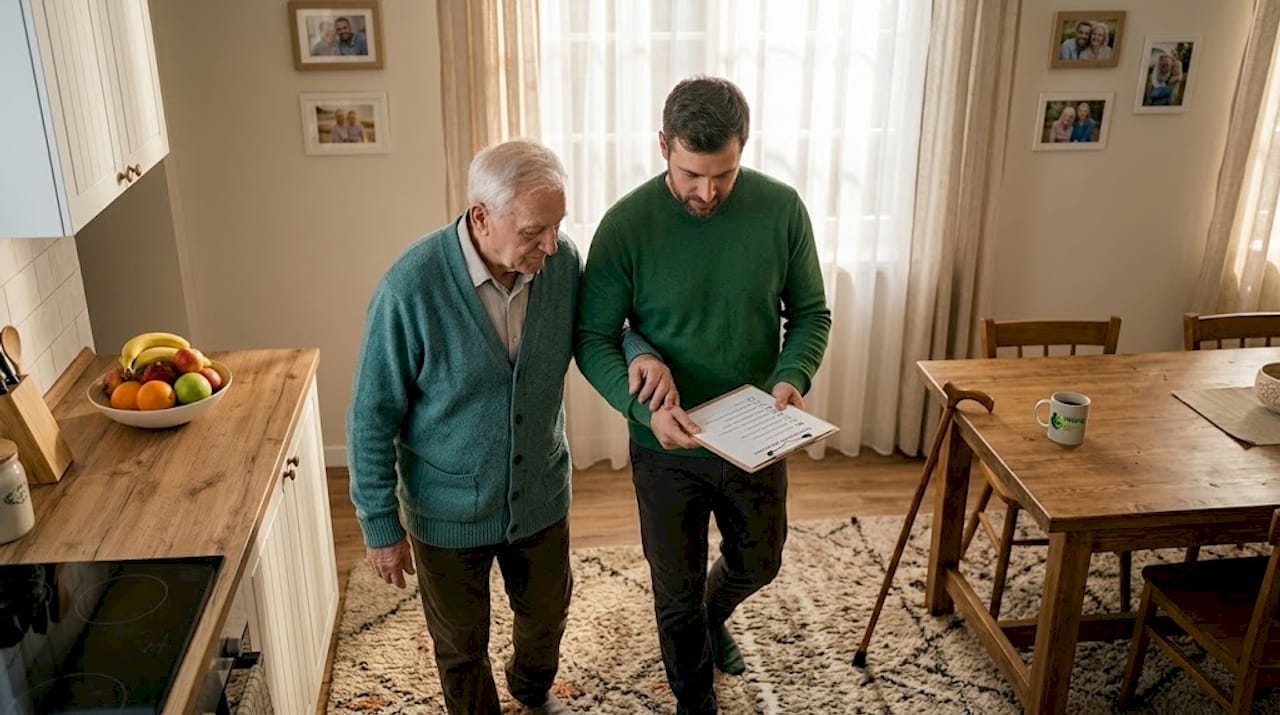
Healthcare providers often use two frameworks to organize this kind of assessment. The first covers Activities of Daily Living, or ADLs. The second covers Instrumental Activities of Daily Living, or IADLs. Understanding both gives you a clearer picture than a general sense that "things seem fine" or "something feels off."
| Category | What it covers | Examples |
|---|---|---|
| ADLs (basic self-care) | Physical tasks needed for personal care | Bathing, dressing, eating, toileting, transferring, continence |
| IADLs (independent living) | Higher-level tasks for living independently | Managing medications, cooking, driving, handling finances, using a phone |
IADLs tend to decline before ADLs, which means noticing trouble with finances or medication safety often signals earlier-stage changes worth addressing now. The questions to ask aging parents guide offers a practical list you can use at home before involving any professional.
Home safety also deserves a careful look. Common hazards include loose rugs, poor lighting in hallways and bathrooms, no grab bars near the toilet or shower, and cluttered pathways. These are not small things. Preventing falls at home is one of the most impactful steps you can take—falls are the leading cause of injury in older adults, and many of those injuries happen in familiar rooms your parent considers perfectly safe. Use our home safety checklist for seniors to walk through each room systematically.
Pro Tip: Walk through your parent's home slowly, at their pace, and pay attention to where they hesitate or reach for support. That physical hesitation tells you more than any checklist.
Don't overlook emotional and social well-being either. Isolation quietly accelerates cognitive and physical decline in older adults. If your parent has lost a spouse, stopped driving, or seen friendships thin out, those losses shape their quality of life as much as any medical condition. Ask directly, and gently, whether they feel connected to people they care about.
This is the section most families delay the longest, and the one that causes the most pain when left undone. The time to gather and execute these documents is now, while your parent is fully capable of making decisions.
Advance directives include a living will and a medical power of attorney. Together, they tell healthcare providers what your parent wants if they can no longer speak for themselves. Without them, medical teams must rely on family consensus, which often breaks down under stress. Medicare covers advance care planning discussions annually as part of the wellness visit, so your parent's doctor is a natural starting point.
Advance planning combined with informal decision supports helps families avoid guardianship proceedings, which are costly, time-consuming, and deeply distressing. Documents executed during full decision-making capacity cannot be challenged on those grounds later. That timing is not a formality. It's the whole point.
If your parent doesn't yet have these documents, contact your local Area Agency on Aging or a licensed elder law attorney. Many offer low-cost or sliding-scale services specifically for this purpose.
One of the most common mistakes families make is treating "assisted living" as the only alternative to living at home. There are actually four primary care pathways worth understanding, and each one suits different circumstances.
| Care option | Best suited for | Key consideration |
|---|---|---|
| Aging in place | Good health, safe home, strong social network | Requires ongoing home modifications and community support |
| Downsizing/relocating | Parent wants less upkeep, wants to be closer to family | Emotional adjustment to leaving a longtime home |
| Senior living communities | Active seniors seeking social connection and low maintenance | Costs vary widely; visit several before choosing |
| Assisted living or nursing care | Significant ADL support needs, medical complexity | Highest cost; insurance and Medicaid planning matters |
Early planning preserves options. Families who begin researching assistive living options before a crisis hits have time to visit multiple communities, compare costs, get on waiting lists, and make considered decisions. Families who start after a hospitalization often have days, not months, to decide.
The right option isn't always obvious at first. It often becomes clearer through the conversation and assessment work you've already done.
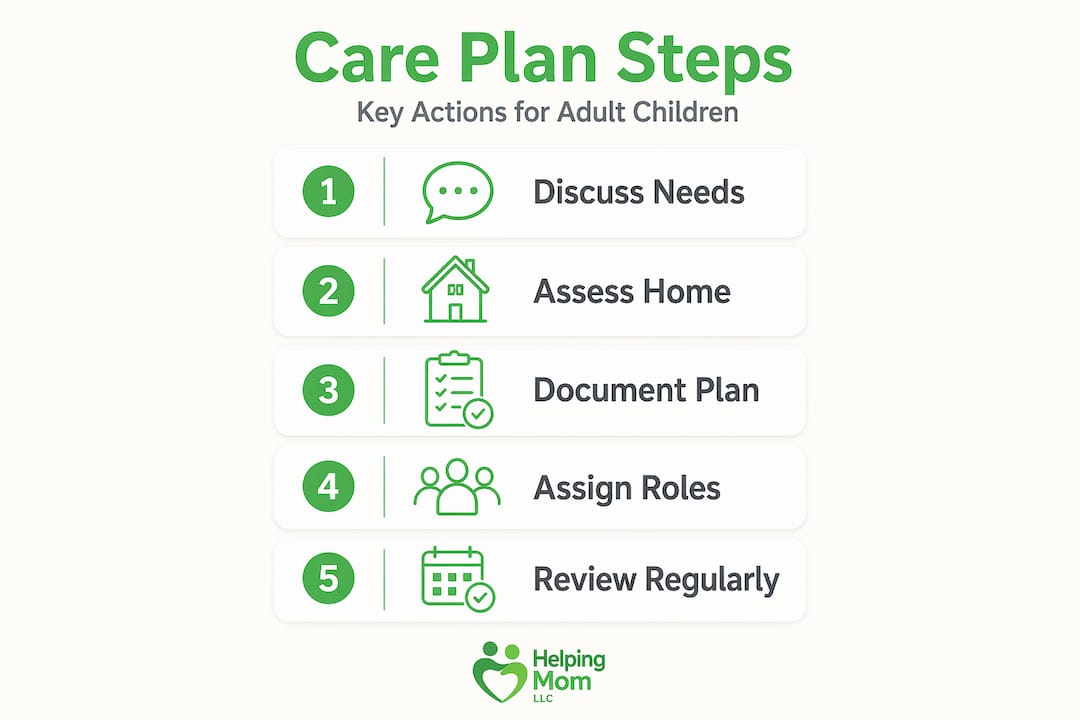
A care plan isn't a single document you fill out once and file away. Think of it as a living record that grows with your family's understanding and your parent's changing needs. Care plans shared across family and care team members allow for faster, more coordinated responses when health changes happen.
Assign roles clearly. Who manages medications? Who attends medical appointments? Who handles the finances? When these responsibilities are documented, family members spend less energy renegotiating and more time actually helping. A printable caregiver schedule can make role assignments practical and concrete.
Schedule a review of the plan every six months, and also after any major event like a hospitalization, a fall, or a significant change in mood or cognition. Consider using a shared folder or a simple app that all key family members can access. Transparency prevents the kind of miscommunication that turns into conflict.
I've heard from hundreds of families over the years, and the pattern that shows up most consistently is this: the families who planned early didn't just have less chaos. They had less guilt. When your parent's wishes are written down and talked through ahead of time, you're not guessing under pressure. You're carrying out a plan your parent helped create.
The emotional toll of caregiving is real, and I won't minimize it. But I've found that a great deal of the heaviest weight comes not from the care itself, but from uncertainty. Not knowing what your parent would want. Not knowing whether you're making the right call. A care plan doesn't remove the hard moments. It does give you something solid to stand on when those moments arrive.
The most common mistake I see is families treating legal documents as a separate project from care planning. They're not. The power of attorney and the conversation about care preferences belong in the same folder, literally and figuratively. And the second most common mistake is waiting for the "right time" to have the first conversation. There isn't one. There's only now, when your parent can still fully participate in shaping their own plan.
Start small if that's what it takes. One honest conversation. One document reviewed. One visit to a senior community just to look around. Small steps, taken early, are the whole point.
— Mike
The best elder care plans are not built around control. They are built around trust, preparation, communication, and presence. Planning ahead gives families more room for calm conversations and fewer rushed decisions during stressful moments.
Your role is not to take over your parent's life. It's to help create support, clarity, and safety while preserving dignity and independence whenever possible.
Print this out and keep it where you can see it. Small steps add up.
We believe that a well-made care plan works best alongside a safe, comfortable home. If your parent wants to stay home as long as possible, the physical environment matters as much as the paperwork. Remember: your well-being matters too. Caregiver burnout is real, and taking care of yourself is not selfish—it's necessary for you to be able to care for others.
Common hazards and practical modifications, room by room
Support independence long-term, not just patch immediate problems
Address the stress and emotional weight of caregiving
A concrete first step you can take this week
A care plan should document your parent's health conditions, daily needs, legal documents, emergency contacts, and who is responsible for each aspect of care. Care plans evolve over time and should be reviewed regularly as needs change.
The right time is before a crisis occurs, ideally while your parent is healthy enough to participate fully in the decisions. Advance directives executed during full capacity are legally stronger and ensure your parent's wishes are honored.
The four primary options are aging in place, downsizing or relocating, senior living communities, and assisted or nursing care. Early research into these pathways gives families the time to compare, visit, and decide thoughtfully.
At minimum, every older adult should have a durable power of attorney for finances, a healthcare power of attorney, and a living will. Advance directives guide medical providers when your parent can no longer speak for themselves.
The Eldercare Locator is a free national service that connects families to local support programs, in-home care, transportation, legal aid, and more. You can reach them by phone, chat, or email.