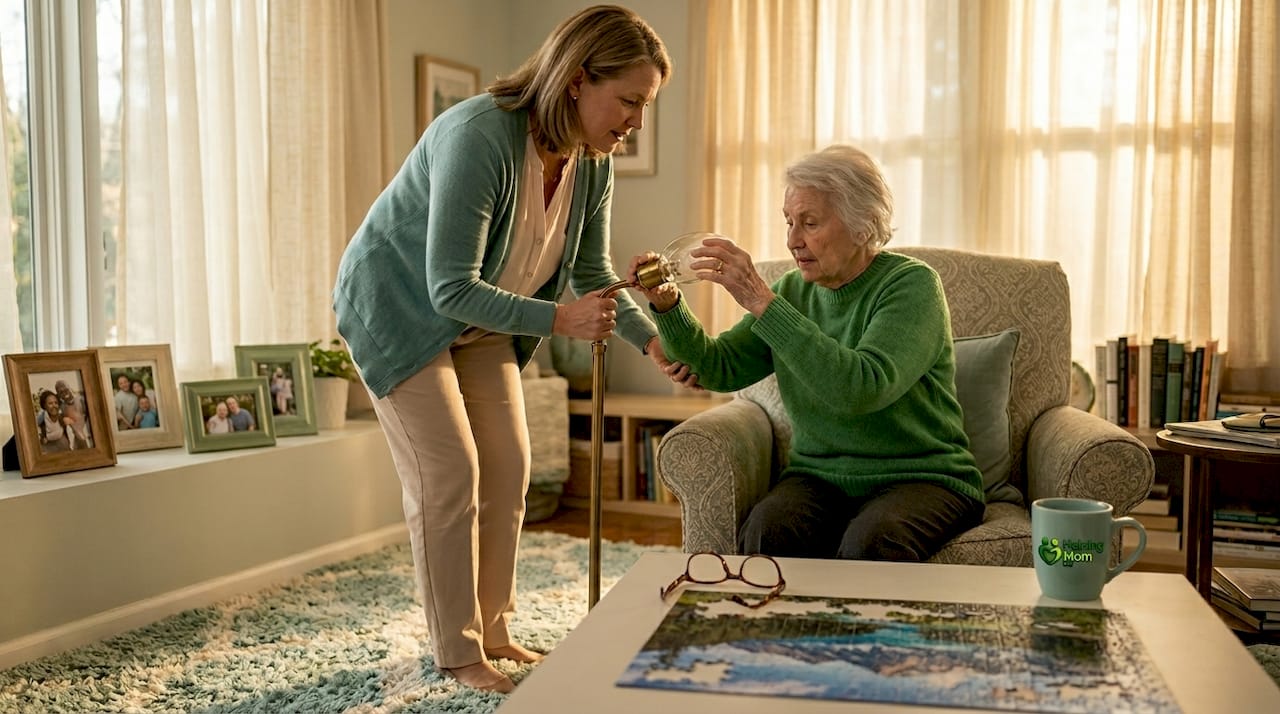
Your mom reaches for something on a high kitchen shelf, loses her balance for just a moment, and grabs the counter to steady herself. Nothing happens this time. But that near-miss lingers in your mind long after you've gone home. You want her to stay in the house she loves, close to her neighbors and routines, but you're starting to wonder whether the home is really set up to keep her safe. The good news is that most homes can become significantly safer with small, thoughtful changes made over time.
Systematic hazard inspections can dramatically lower the risk of falls and accidents for aging parents.
Evidence-backed upgrades like grab bars and better lighting support daily function and dignity.
Bathrooms are a top source of falls, so focus immediate attention on safety improvements there.
For memory loss or complicated family setups, smart home devices add safety and reassurance.
Monitoring falls and satisfaction ensures your efforts are working and shows when to update your plan.
Understanding what aging in place means is the foundation of everything that follows. Simply put, aging in place is the ability to live in your own home safely and independently as you grow older, with or without some extra help. For most older adults, that's exactly what they want.
The emotional rewards are real. Familiar surroundings reduce stress. Long-standing routines support mental well-being. Staying close to neighbors, friends, and community gives life meaning in ways that a move to a facility simply cannot replicate. For your parent, home is more than a place to live. It holds routines, memories, comfort, and a sense of identity.
But risks are real too, and they deserve honest attention:
The leading cause of injury among older adults, and most happen at home.
Creeps in when mobility decreases and driving stops.
Can accelerate when a home isn't set up to support changing abilities.
And kitchen accidents become more likely as memory and coordination shift.
"The goal isn't to build a fortress. It's to quietly remove the obstacles that stand between your parent and the life they want to keep living."
Planning ahead is not about expecting the worst. It is about making small adjustments now so daily life stays safer and less stressful later. Research shows that targeted modifications boost self-rated health and life satisfaction, particularly for those living alone, and challenge the assumption that institutional care is the only safe path forward.
Now that you understand the stakes, the most useful thing you can do is walk through your parent's home with fresh eyes. You're looking for everyday hazards that have become invisible through familiarity.
The CDC STEADI program (Stopping Elderly Accidents, Deaths, and Injuries) offers one of the clearest room-by-room guides available. Check for:
Use our detailed home safety checklist to work through each room systematically.
| Home area | Common hazards | Priority level |
|---|---|---|
| Bathroom | Wet floors, no grab bars, poor lighting | Very High |
| Stairs | No handrails, poor lighting, clutter | High |
| Bedroom | Low bed height, dim lighting, cords | High |
| Kitchen | Reaching up high, slippery floors | Medium |
| Entryways | Uneven steps, poor lighting, loose mats | Medium |
| Living room | Loose rugs, low furniture, cords | Medium |
Do the walk-through visit at dusk or in dim lighting. Hazards that seem obvious in bright daylight often become invisible after dark, which is exactly when many falls happen.
A systematic walk-through takes about 30 to 45 minutes. Many families are surprised by how reassuring these small changes can feel once they are actually completed. It's one of the highest-value things you can do as a caregiver, and it costs nothing but time.
With your hazard list in hand, you can move from observation to action. The most effective approach is to prioritize by risk, not by convenience.
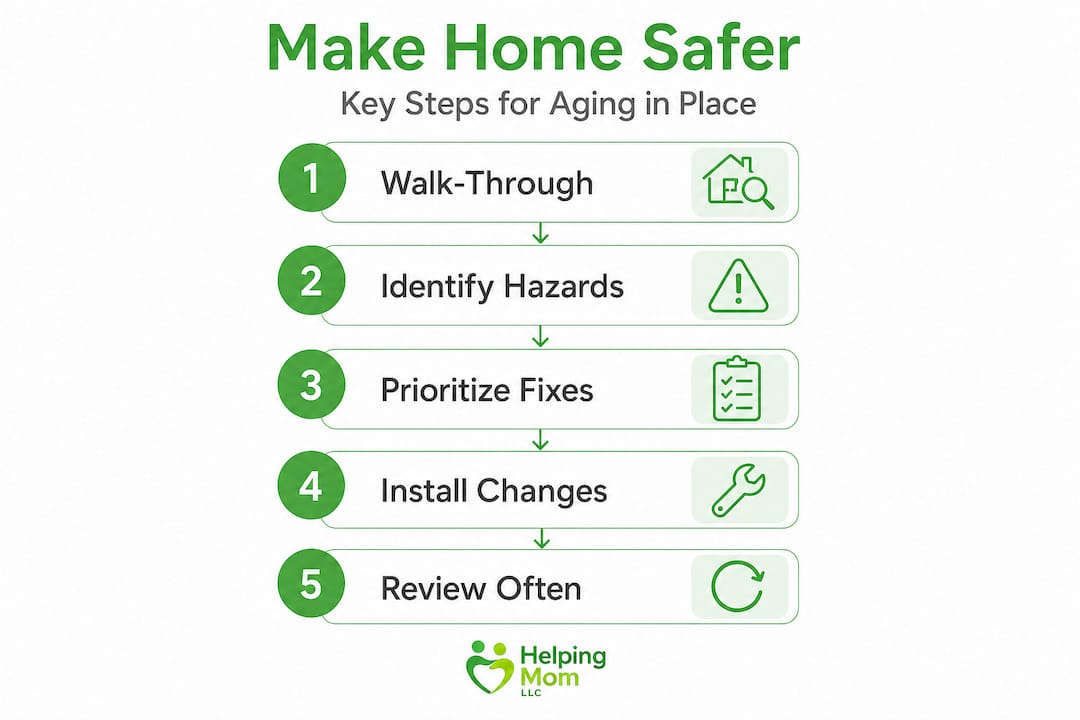
Targeted aging in place modifications have strong evidence behind them. Research shows that home modifications reduce falls by about 33%, and 65% of studies confirm modifications are effective for fall prevention, functional independence, and even cost savings compared to injury treatment.
That last point matters. A grab bar costs $30 to $80 installed. A fall-related hospitalization can cost tens of thousands of dollars and lead to months of recovery.
| Modification | Approximate cost | Impact on safety |
|---|---|---|
| Grab bars in bathroom | $30 to $150 installed | Very High |
| Non-slip floor mats | $15 to $40 | High |
| Improved lighting | $20 to $100 per fixture | High |
| Stair handrail addition | $150 to $400 | High |
| Lever door/faucet handles | $30 to $80 each | Medium |
| Bed rail or raised toilet seat | $25 to $75 | Medium |
| Ramp over front steps | $500 to $2,000 | Varies |
"Consistency matters more than perfection. Small improvements made over time often create the safest and most sustainable results."
Start with the changes that cost the least and deliver the most:
They're affordable, fast to install, and proven to help. Our guide to preventing falls at home walks you through each modification in more detail.
The bathroom deserves its own section because the risk there is genuinely higher than anywhere else in the home. Bathrooms combine slippery surfaces, tight spaces, hard flooring, and frequent movement, which is why so many falls happen there.
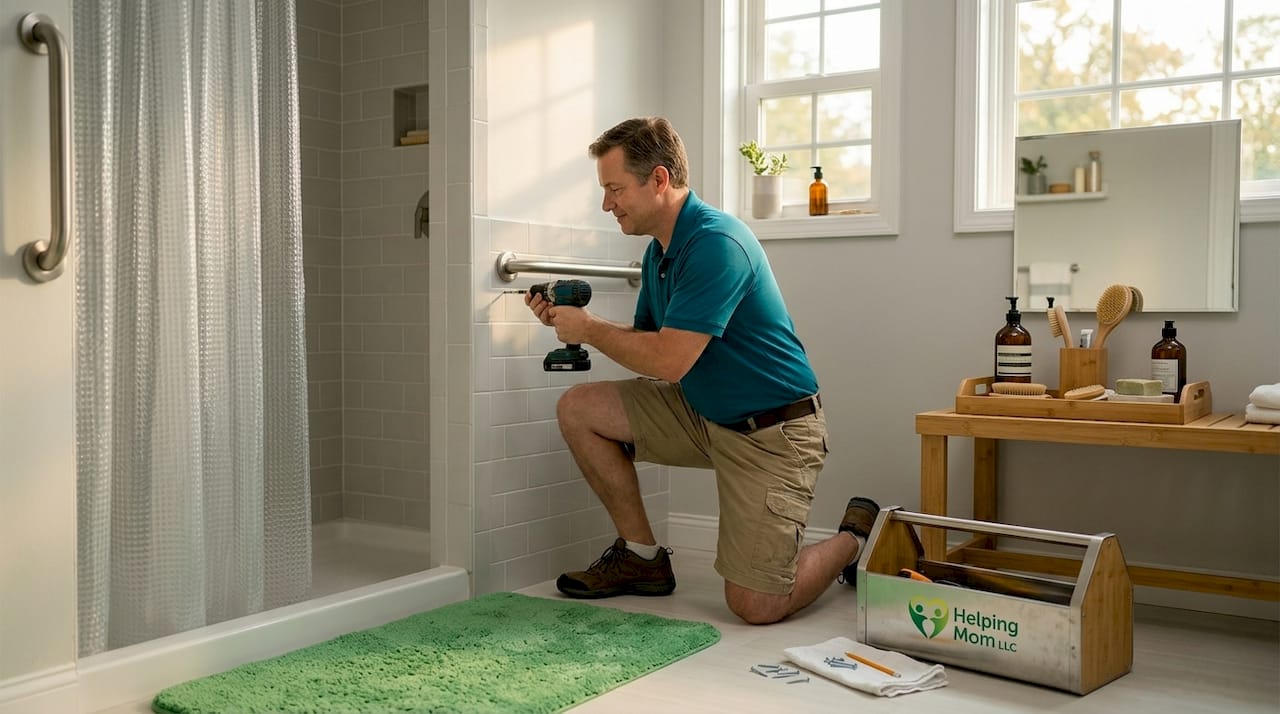
Bathroom safety for aging adults centers on a few key priorities: grab bars near the toilet and in the shower or tub, non-slip mats inside and outside the tub, adequate lighting, and lever-style faucet handles that are easier to turn with arthritic hands.
Your parent pushes up and lowers down multiple times each day. A bar on the side wall gives them something solid to hold.
These go on the entry wall and along the shower wall for support while bathing.
The adhesive kind works well and can be replaced every year or two as they wear.
Make sure it has a non-slip backing and lies completely flat.
Many falls happen on nighttime bathroom trips. A small LED nightlight costs just a few dollars.
They require no gripping or twisting, which makes them significantly easier for anyone with reduced hand strength.
If your parent struggles to rise from low positions, this is a simple and effective addition.
When choosing grab bars, look for ones rated to hold at least 250 pounds and make sure they're anchored into wall studs or with proper anchors. A grab bar that pulls out of the wall is worse than no bar at all.
Not every family situation is straightforward. If your parent has some memory loss, or if they're moving in with you, the standard safety checklist is still relevant but needs a few additions.
Smart home technology for aging in place has matured significantly. For parents with cognitive decline such as early Alzheimer's, technology can fill safety gaps while preserving dignity in ways that constant supervision cannot. The goal is to use tools that support independence rather than remove it.
These attach to the stove and cut power if the burner is left on too long without activity nearby. They're affordable and can prevent kitchen fires.
A simple sensor with an alert to your phone lets you know if your parent leaves the house at an unusual hour without creating a locked-in feeling.
Automatic pill dispensers can alert your parent when it's time to take medication and dispense the correct dose, reducing errors without requiring daily intervention from you.
A smart speaker placed in a common area lets your parent call for help, set reminders, play music, or check the weather without needing to navigate a phone.
Introduce one device at a time and let your parent get comfortable with it before adding another. Overwhelming someone with new technology all at once leads to frustration and abandonment.
For families in multi-generational homes, clear boundaries matter just as much as safety hardware. Decide together where your parent's private space begins and ends. Establish routines that give everyone predictability.
Explore our guide on technology for aging parents →Making changes is only half the work. You also need to know whether those changes are actually helping. This is where many families stop short, assuming that because they installed grab bars, everything is fine.
Research shows that targeted changes
Improved daily activity difficulties by 38%
on average in government-funded home modification programs
| What to track | How often | What to look for |
|---|---|---|
| Falls or near-falls | Every visit | Any fall or close call worth noting |
| Daily activity confidence | Monthly | Ask your parent how they feel moving around the home |
| Pain or discomfort | Monthly | New soreness that might signal a hard-to-see issue |
| Bathroom independence | Monthly | Are they managing safely on their own? |
| Sleep quality | Occasionally | Nighttime trips are a common fall risk |
Beyond tracking, ask your parent directly. How confident do they feel walking to the bathroom at night? Do they feel steadier on the stairs? Their own sense of security is an important measure of success.
signals that something still needs attention.
around certain areas of the home, like skipping stairs or avoiding the shower.
that affects how steadily they move.
that affect balance or alertness.
Our collection of essentials for aging safely includes a simple review framework you can revisit every few months.
Here's something most safety guides won't tell you: the grab bars and the checklists are the easy part. The hard part is everything that surrounds them.
"When you suggest removing a throw rug your parent has had for 30 years, you're not just suggesting a safety change. You're touching their sense of control over their own home and their own life."
When you bring up adding a shower chair, they may hear something you didn't say: that you think they're becoming frail. Resistance isn't stubbornness. It's a very human response to feeling like something is being taken away.
Families who navigate aging in place successfully tend to share one trait: they have honest, unhurried conversations early. Not crisis conversations, but low-stakes talks that happen before anything goes wrong.
Talking with aging parents about safety works best when it comes from curiosity and care rather than urgency or worry.
are often the ones who wait until after a fall to have those conversations. At that point, fear is in the room, and decisions get made under pressure rather than thoughtfully.
Your parent's reluctance is information. It tells you something about what feels meaningful to them, what they're afraid of losing, and where your energy is best spent. Listen before you install. Ask before you rearrange. The best home modifications are the ones your parent actually embraces, not the ones they tolerate.
Many adult children carry quiet stress and guilt while trying to balance safety, independence, work, and family responsibilities all at once.
This journey isn't about taking over. It's about walking alongside your parent, at their pace, toward a home that supports the life they want to keep living.
If you've found this guide useful, there's much more support waiting for you. Helping Mom offers in-depth resources covering every aspect of aging in place and home safety, from room-by-room guidance to conversations with resistant parents.
Comprehensive resources for every room and situation.
Download and use on your next visit.
Step-by-step planning support for families.
Tools for every step of the journey.
Whether you're just starting to notice small changes in your parent or you're already managing significant safety concerns, you don't have to figure this out alone.
Helping Mom exists to make these conversations and decisions feel a little less overwhelming and a little more manageable.
Practical steps to create a safer living environment for your aging parent.
A comprehensive guide to home safety modifications.
Printable checklist to use during your home safety assessment.
Everything you need to know about keeping your parents safe at home.