Senior Care Resources
Discover practical tips and adjustments that help your loved ones thrive safely while maintaining their independence.
Watching your parent move through daily life a little more cautiously than before can bring up a mix of emotions: concern, love, uncertainty, and the very real question of how to help without taking too much away.
The good news is that aging at home does not have to mean giving up independence. With thoughtful adjustments, open conversations, and a safer environment, many older adults can continue living confidently in the homes they love.
Falls cause most injuries in older adults and can be greatly reduced by removing home hazards and improving safety.
Simple changes like grab bars, non-slip mats, and proper lighting enable safer mobility and boost confidence.
Regular, moderate exercise improves strength and balance, directly supporting seniors' ability to live independently.
Telehealth and smart home devices help seniors manage health and emergencies, preserving their independence.
Proactive, collaborative planning with seniors avoids crises and ensures smoother, respectful aging-in-place.
To effectively support senior independence, it's important to grasp the risks aging parents face daily at home. This isn't about cataloging everything that could go wrong. It's about seeing your parent's world clearly so you can make changes that actually matter.
One in four older adults falls annually, and falls are the leading cause of injury-related deaths among seniors. That number is striking, but what's just as important is what leads up to a fall. It's rarely one thing.
More often, it's a series of small changes that quietly build over time until everyday routines start feeling harder than they used to.
Physical changes accumulate quietly. Strength, balance, and vision all shift with age, often before anyone notices. A rug that was never a problem becomes a hazard. A dark hallway at 2 a.m. becomes a genuine risk. Add in emotional factors, like the fear that sets in after a near-miss or an actual fall, and you get a cycle where seniors move less to feel safer, which actually increases their risk over time.
Understanding these overlapping risks is the first step toward making home safer for seniors in a way that feels manageable rather than overwhelming.
With an understanding of risks, the next step is to prepare the home with modifications that foster safety and independence. Many meaningful safety improvements are simpler and more affordable than families expect.
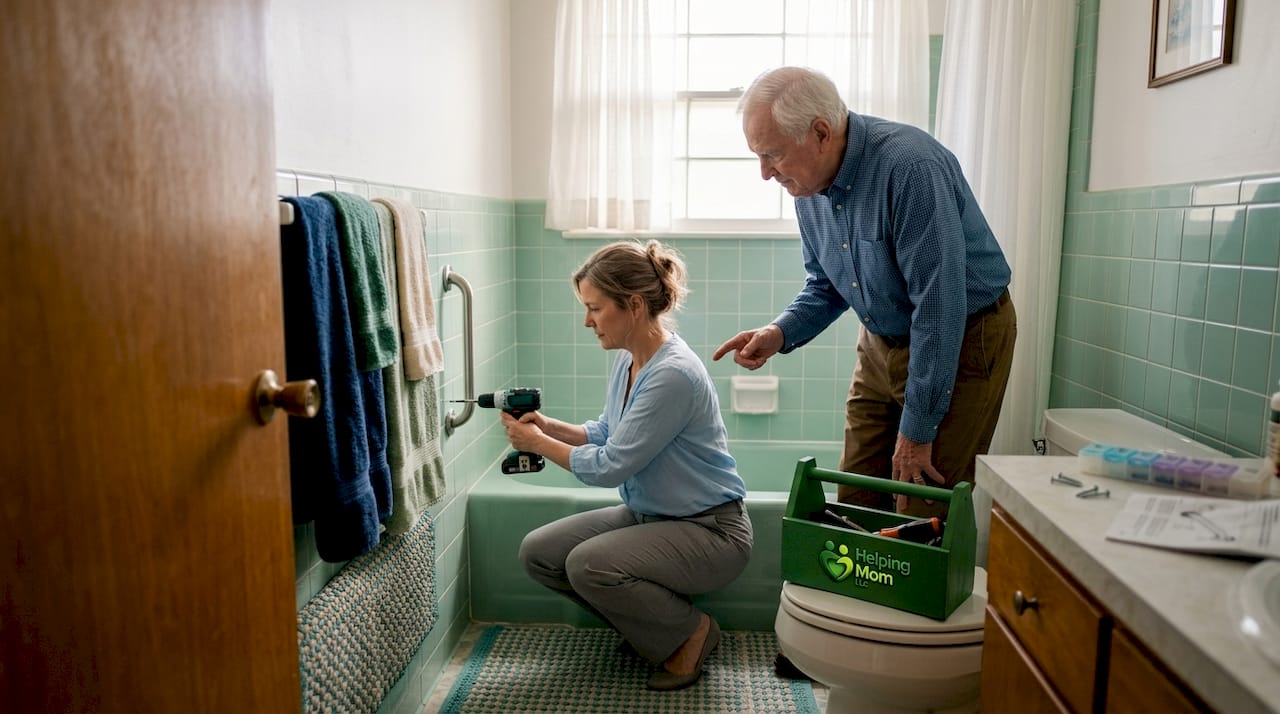
Installing grab bars, using non-slip mats, and ensuring handrails on both sides of stairs reduce fall risks by addressing 75% of home hazards. Small changes often create the biggest improvements in confidence and safety. And when it comes to the bathroom, grab bars run $20 to $40, raised toilet seats $30 to $60, and shower benches $40 to $70, making safe bathroom use accessible without a major renovation.
Grab bars near toilet & shower, shower bench, non-slip bath mat, raised toilet seat
Lamp within arm's reach, bed rail if needed, clear path to bathroom
Items at counter height, sturdy step stool with handrail for higher shelves
Motion-activated nightlights, handrails both sides, remove loose rugs
Wide clear pathways, firm armrests on chairs for easy sitting/standing
| Modification | Estimated Cost | Where It Helps Most |
|---|---|---|
| Grab bars | $20 - $40 | Bathroom, shower, tub |
| Raised toilet seat | $30 - $60 | Bathroom |
| Shower bench | $40 - $70 | Bathroom |
| Motion-activated nightlight | $10 - $20 | Hallways, bedroom |
| Non-slip rug backing | $10 - $25 | Any room with rugs |
| Handrail extension | $40 - $100 | Stairs, entryways |
When shopping for grab bars, look for models rated to hold at least 250 pounds and check that they can be mounted into wall studs. A bar that pulls away from the wall is worse than no bar at all.
Beyond home safety, supporting seniors' physical strength and balance is key to maintaining independence. The home environment sets the stage, but your parent's body has to feel capable of moving through it confidently.
Older adults should aim for 150 minutes of moderate aerobic activity and two days of muscle-strengthening each week to maintain independence. That might sound like a lot, but it breaks down to about 30 minutes of gentle movement five days a week combined with simple strength exercises twice a week.
Three hours of weekly physical activity, including balance exercises, significantly improves walking speed, grip strength, and reduces fall risk. Balance exercises are especially important because they directly reduce fall risk and improve confidence with daily movement.
Short, low-intensity walks around the house or yard, 5-10 minutes at a time.
Add seated leg lifts or wall push-ups to build lower and upper body strength.
Introduce balance exercises like heel-to-toe walking or single-leg stands.
Join community exercise classes or walking buddy programs for social motivation.
The social piece matters more than most people expect. A parent who exercises with a friend or group is far more likely to stay consistent than one doing it alone.
Even a short weekly walk with a friend or neighbor can make routines feel more sustainable and less isolating. Check local senior centers, libraries, and community health programs for free or low-cost options.
If your parent is hesitant about "exercise," reframe it. Ask if they'd like to take a short walk with you after dinner, or if you can do a stretching routine together while watching TV. The activity matters more than what you call it.
In addition to physical and home adaptations, technology and healthcare tools can boost seniors' safe independence. Technology can feel intimidating at first, but many tools designed for older adults are becoming easier and more practical to use every year.
Health technology navigators help seniors use telehealth and patient portals, bridging transportation or language barriers to maintain healthcare access. If your parent misses appointments because driving feels stressful or public transit is unreliable, telehealth alone can be a meaningful shift. Many primary care practices now offer it as a standard option.
Devices worn as a wristband or pendant that automatically call for help if a fall is detected, even if your parent can't press the button.
Lights that turn on automatically when someone enters a room, reducing the need to fumble for switches at night.
Devices that allow your parent to set medication reminders, make calls, or turn off lights without getting up.
Video or phone appointments that keep your parent connected to their care team from home.
One thing that rarely gets mentioned: The biggest barrier to technology adoption isn't the technology itself—it's confidence. Sitting down with your parent to set up a device together, and practicing using it a few times, dramatically increases the chance they'll actually use it. Family involvement makes all the difference.
Understanding hazards and tools is vital, but knowing common mistakes helps you support your parent more thoughtfully. The most well-intentioned changes can backfire if they're done to your parent rather than with them.
Families often wait for hospitalization before seeking professional support; early planning and in-home assessments prevent crises and fragmented care. This is probably the most common pattern. Many families wait until something serious happens before making changes. By then, decisions are often being made quickly, emotionally, and under stress. Starting early changes that entirely.
"Over-surveillance can feel infantilizing; using selective smart sensors for pattern tracking rather than constant monitoring respects dignity."
— Caring Senior Service
There's an important balance between safety and dignity. There's a real difference between a motion sensor that alerts you if your parent hasn't opened the kitchen cabinet by noon (a gentle check-in) and a camera system that monitors every room. One supports independence. The other quietly erodes it.
Making home modifications or starting conversations only after a health event occurs.
Implementing changes that your parent didn't participate in, leading to resistance and resentment.
Overwhelming your parent with simultaneous modifications that feel disorienting.
Purchasing tools like reachers or button hooks without trying them first for fit and comfort.
Controlling your parent to the point where they feel supported rather than empowered.
Before purchasing any adaptive tool, check if your local library or senior center has a lending program. Many do. Your parent can try a tool for a few weeks before you commit to buying it.
Here's something worth sitting with: the families who navigate this journey most successfully aren't the ones with the most resources or the best equipment. They're the ones who started the conversation before it became urgent.
Starting aging-in-place planning before age 72 with thorough home safety assessments greatly improves outcomes and options. When planning happens early, your parent has the cognitive and emotional capacity to participate fully. They can tell you what matters to them, what they're willing to try, and where they draw their limits. That input is invaluable, and it's often unavailable after a health crisis.
There's also something deeper here about dignity. When an adult child swoops in after a fall and starts rearranging furniture, installing cameras, and hiring help, the message received—however unintentionally—is often "you can no longer be trusted to manage your own life." When the same changes happen gradually, collaboratively, with your parent's full participation, the message is entirely different.
A professional home safety assessment can help bridge the gap between what you notice and what you might miss. Occupational therapists who specialize in aging in place can identify hazards you've walked past a hundred times and suggest solutions your parent is more likely to accept from a neutral professional than from you. It's not a reflection of your care; it's just how family dynamics work.
Think of this as a timeline, not a checklist.
The earlier conversations begin, the more likely your parent is to feel included rather than managed.
Small changes, made early, made together, give your parent the best chance of staying in the home they love, on their own terms. That's what promoting senior autonomy actually looks like in practice.
You've already taken an important step by learning more about how to support your parent safely and respectfully at home.
Helping Mom offers practical guides, home safety checklists, and aging-in-place resources designed specifically for adult children navigating these conversations and decisions.
Whether you're making small home updates or starting bigger planning discussions, you don't have to figure it out alone.
Installing grab bars near toilets and showers, improving lighting in hallways and bathrooms, removing trip hazards like loose rugs, and adding non-slip mats are the highest-impact starting points. These changes address the majority of fall risks found in most homes.
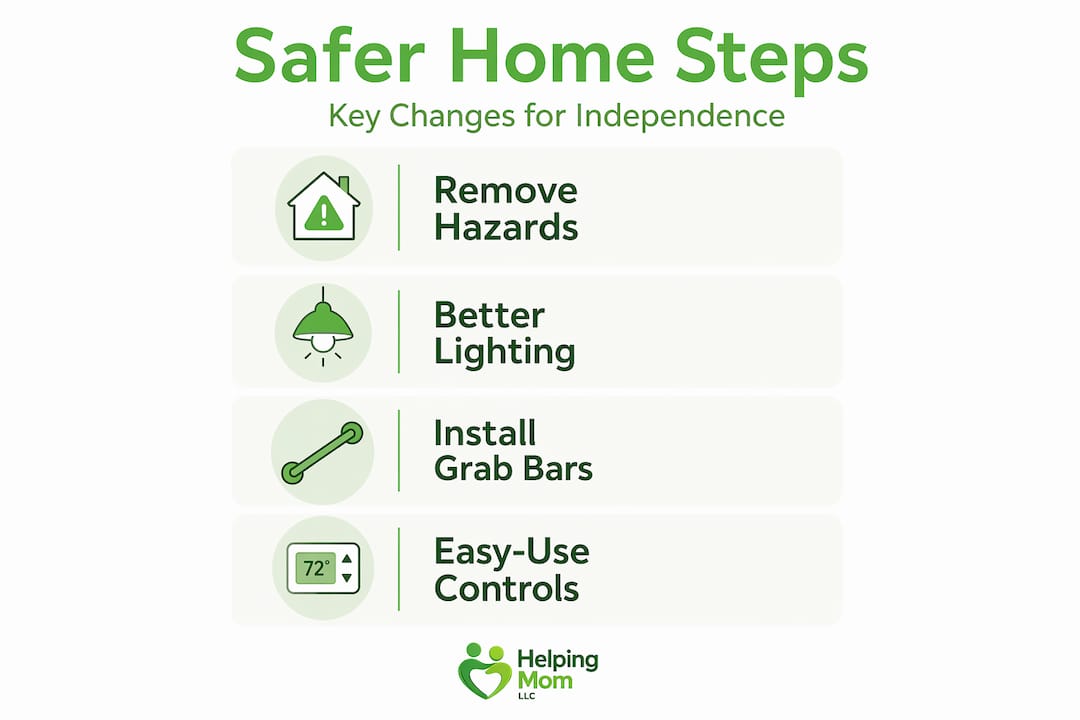
Older adults should aim for at least 150 minutes of moderate aerobic activity weekly plus two muscle-strengthening days per week to maintain physical function and independence. Balance exercises, often overlooked, are equally important for reducing fall risk.
Telehealth, medical alert systems with fall detection, and smart home devices like voice assistants and motion-activated lighting all make daily life safer and more manageable. Health technology navigators can also help seniors learn to use these tools with confidence.
Starting before age 72 is ideal. Early home assessments allow time for gradual changes, give your parent a meaningful role in decisions, and prevent the rushed planning that often follows a health crisis.
Comprehensive guide to aging in place with expert recommendations.
Printable checklist to systematically assess home safety.
Detailed guide for elderly parents' home safety needs.
Thoughtful approach to aging in place modifications.