Considering an independent living facility for a parent? This guide helps you understand what they are, who they're for, and how to start the conversation.
An independent living facility is a housing community designed for older adults who are active and self-sufficient. It's less about needing care and more about choosing a lifestyle that trades home maintenance for convenience, community, and peace of mind.

If you're just starting to look at options for your parent, the word "facility" can feel a little cold. That hesitation is completely normal. It's helpful to know that independent living is fundamentally different from other kinds of senior care. Its main purpose isn't medical support—it's about making life easier and more enjoyable.
These communities are designed for older adults who can manage their day-to-day lives, such as dressing, bathing, and taking their own medications. The real focus is on taking care of the background chores that can start to feel like a burden over time.
Imagine your parent no longer having to think about mowing the lawn, calling a plumber for a leaky faucet, or worrying about shoveling snow. An independent living community handles all of that. This simple shift frees up their time and energy for the things they actually want to do—hobbies, friendships, and new activities.
"Instead of seeing it as a loss of independence, many families discover it's the exact opposite. It's a way for a parent to hold onto their autonomy by letting go of the responsibilities that were starting to weigh them down."
One of the biggest benefits is the built-in social connection. While your parent has their own private apartment or home, the community offers a ready-made network of peers and a calendar full of optional things to do. This can make a world of difference, especially if your parent has been feeling a bit isolated at home.
Ultimately, exploring an independent living facility can be a proactive step toward a more vibrant and less stressful chapter. It's about creating a setting where your parent can keep living life on their own terms, just with a little more support and a lot more community.
Thinking about whether an independent living facility is the right choice for your parent can feel like a huge question. It's rarely about a single event. More often, it's a series of small, quiet shifts you start to notice over time.
This isn't about a clinical checklist. It's a gentle guide to help you pay attention with compassion, not alarm. The goal is to see if a change might add more ease and joy to their life—not take anything away.
For years, your parent's home was a source of pride and comfort. But sometimes, the very things that once felt manageable—the yard, the stairs, the endless maintenance—can start to feel like a heavy weight.
You might see this in small ways. Maybe the garden is a little less tended to than it used to be. Perhaps you hear more comments about the cost of a new roof or the hassle of finding a good plumber. These aren't signs of inability. They're quiet signals that the responsibilities of homeownership might be becoming more stressful than satisfying.
Another thing to pay attention to is your parent's social life. As we get older, our social circles can naturally get smaller. Friends move away, driving at night might become difficult, and it just takes more energy to stay connected.
"It's less about needing someone to talk to and more about having a vibrant community right outside your front door. This shift can turn isolation into effortless interaction."
Ultimately, the best fit for an independent living facility is an older adult who is still managing their own daily care but is ready for a life with more freedom and fewer worries. It's often a choice made from a position of strength and foresight—not a reaction to a crisis.
By focusing on what could be gained—convenience, community, and peace of mind—you can frame the conversation around a positive new chapter. It's a proactive step toward helping your parent stay engaged, active, and, most importantly, in control of their life.
When you first start looking into senior living, the language can be confusing. You'll hear terms like "independent living," "assisted living," and "nursing home" used, sometimes interchangeably. But they represent entirely different levels of support for very different needs.
An independent living facility is like that first apartment after college. It's all about freedom and doing things on your own terms, but with built-in conveniences and a ready-made community. The whole point is lifestyle, not medical care.
Provides no hands-on personal care. Designed for active, self-sufficient older adults who can handle all their daily needs without help. The "support" here is about convenience: meals, housekeeping, and maybe a ride to an appointment.
For when a little help is needed with daily activities. Staff are on hand to assist with personal care, creating a balance between independence and support. Good for someone who can't manage everything alone but doesn't need constant medical oversight.
Provide 24/7 medical care in a clinical setting. For individuals with serious health conditions who need round-the-clock attention from licensed nurses and medical professionals.
| Feature | Independent Living | Assisted Living | Skilled Nursing |
|---|---|---|---|
| Primary Focus | Lifestyle, convenience, social connection | Help with daily activities and personal care | 24/7 medical care and supervision |
| Resident Profile | Active, self-sufficient seniors | Seniors needing some daily assistance | Individuals with significant health needs |
| Housing Style | Private apartments with full kitchens | Private/semi-private rooms, smaller kitchenettes | Hospital-style rooms, often shared |
| Staffing | Hospitality staff (dining, housekeeping) | On-site caregivers available 24/7 | Licensed nurses on duty at all times |
| Cost Structure | Monthly rent covering housing & amenities | Monthly fee with personalized care plan | Daily rate covering all care & meals |
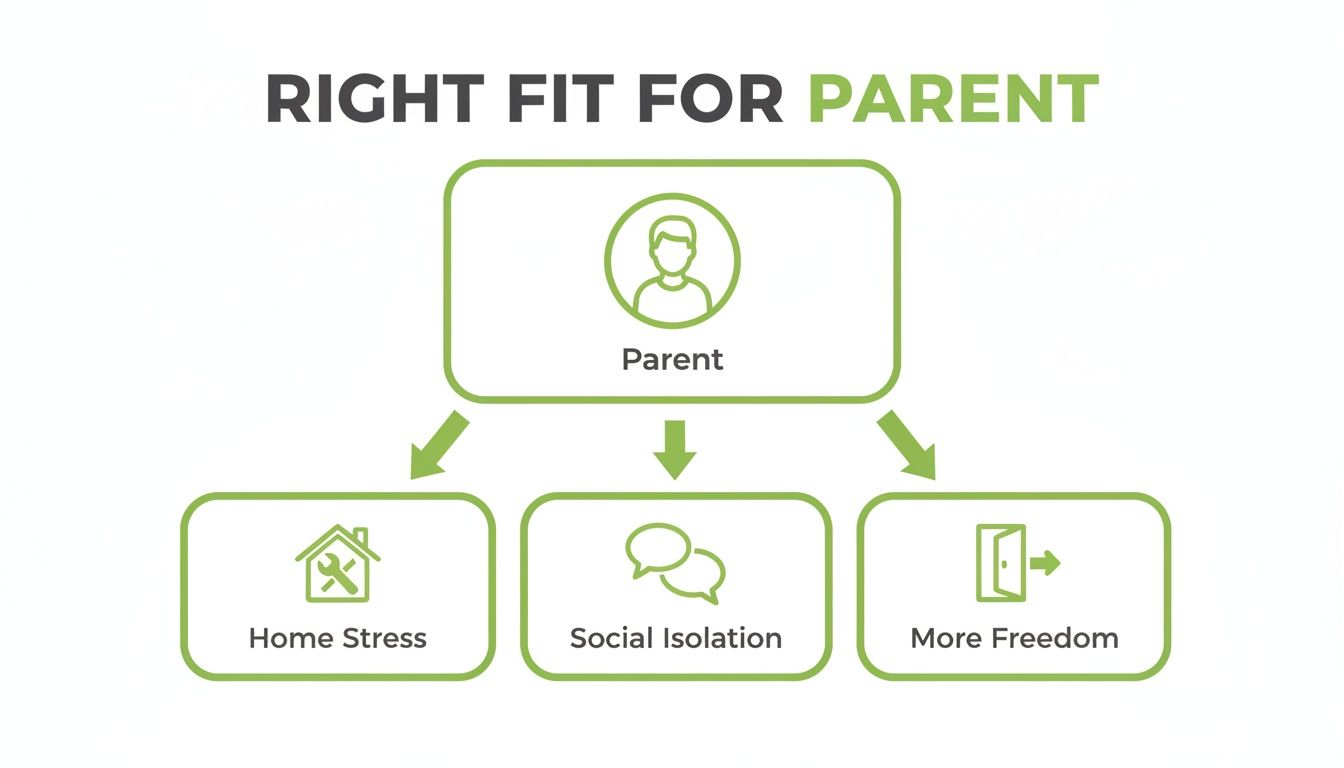
When the fit is right, you're not just finding a new place to live. You're trading the stress of home maintenance and the quiet of an empty house for a life with more freedom, connection, and peace of mind.
The path forward begins with knowing what's out there. As you get more familiar with the landscape, you can find more practical advice in our comprehensive caregiving guide.
It can be hard to picture what daily life in an independent living facility really looks like. The term itself can sound a little impersonal. But in reality, these communities are designed to feel like convenient, active neighborhoods where your parent is still in charge—they just have more options and less on their plate.

Imagine your parent's day. Instead of spending the afternoon trying to get a handyman on the phone, they could be at a book club meeting down the hall. Instead of worrying about driving to an appointment in bad weather, they could just sign up for the community's shuttle.
Flexible options from casual cafes to formal dining. Cook at home or enjoy chef-prepared meals with friends.
Light housekeeping and responsive maintenance included. No more worrying about leaky faucets or changing lightbulbs.
Scheduled trips for groceries, errands, and appointments. Freedom and safety without the stress of traffic.
24/7 on-site staff and emergency call systems in each apartment for peace of mind.
While the practical help is a major draw, the real heart of independent living is the community. Loneliness is a genuine concern for many older adults living alone, but these environments are intentionally built to create easy, low-pressure social connections.
The beauty of it all is that it's completely optional. Your parent has total privacy in their own apartment and decides exactly how much—or how little—they want to participate. It's their home and their schedule, just with more opportunities waiting right outside their door.
Talking about money is rarely comfortable, but getting clear on the financial side of independent living is one of the most empowering things you can do. It takes the "what if" out of the equation and gives you and your parent a real sense of control.
Most communities keep their costs straightforward. You'll usually see a one-time entry or community fee, plus a recurring monthly service fee. This covers the upfront investment and the day-to-day services that make life easier.
Think of the monthly fee as bundling all those scattered household bills into one predictable payment. Instead of juggling a mortgage, utility bills, landscaping costs, and unexpected repair invoices, your parent pays a single, consistent amount.
Important: Medicare does NOT pay for non-medical senior living like independent living communities. Because these places are about lifestyle, not healthcare, payment is almost always handled privately.
"The investment in an independent living facility is not just for a place to live; it's for a stable and supportive environment. This reliability is why the sector is seeing continued growth."
The most common source—using income from pensions, Social Security, 401(k)s, and other retirement accounts.
The equity built up in a family home often covers the one-time entry fee and helps fund monthly costs.
Worth checking your parent's policy—while it doesn't always cover independent living, some policies have applicable benefits.
Getting these financial realities on the table early on makes the whole process feel more manageable. It turns a stressful topic into a practical conversation about resources and what you all want for the future.

This can feel like the hardest part of the process. Thinking about bringing up an independent living facility can feel like walking on eggshells. You want to be helpful, but you're worried about them feeling pushed, judged, or like you're taking away their independence.
If you're feeling that way, it's completely normal. It means you care.
The key is to let go of the idea that this is one big, high-stakes conversation. Think of it more like planting a seed—opening the door for a series of smaller, gentler talks over time. The goal isn't to get a "yes," but simply to make the topic safe to talk about.
How you start this conversation sets the tone for everything else. Rushing it or bringing it up during a tense moment can lead to defensiveness. A calm, unhurried approach is everything.
Don't schedule a formal "talk." Wait for a natural moment. If your parent mentions they're tired of mowing the lawn, that's your opening.
This isn't about telling them what to do. Try: "I was reading about these communities where all the maintenance is handled, and it made me curious what you thought."
Ask open-ended questions and listen: "What are you looking forward to most in the next few years?" or "Is there anything that worries you about staying in the house long-term?"
"The most productive conversations aren't about convincing your parent of anything. They are about exploring possibilities together, with their autonomy and happiness as the true north."
No one gets excited about giving things up. But people do get excited about getting more of what they want. Connect the idea of an independent living facility to something they value.
"I know how much you enjoy your book club. Some of these places have tons of groups and classes right there, so you don't even have to drive."
"It seems like it would be so much easier to just lock the door and go on a trip without worrying about the house."
"Imagine having all that time you spend fixing things to do more of what you actually enjoy."
This is a gradual process built on trust. By leading with curiosity and genuine concern for their happiness, you can turn a topic that feels uncertain into a collaborative exploration of what comes next.
As you start exploring what an independent living facility could look like for your parent, it's completely normal for practical questions to bubble up. Getting clear, honest answers is how you build confidence for the road ahead.
At Helping Mom LLC, we provide calm, practical guidance to help you support your parent with confidence and compassion.
Article created using Outrank
Helping Mom provides calm, practical guidance for adult children supporting aging parents. Explore our guides and checklists for making homes safer, having difficult conversations, and caring for yourself along the way.
View Our Caregiving ChecklistLooking for more calm, practical guidance for supporting an aging parent?
Visit the Helping Mom Caregiving Resource Library to explore our full collection of caregiving guides, home safety resources, and practical checklists designed for adult children helping aging parents.
Browse the Caregiving Resource Library