
TL;DR
Normal aging and dementia are fundamentally different conditions, and knowing that difference is one of the most practical things you can do as a caregiver. Normal cognitive decline brings minor, gradual changes that do not disrupt daily life. Dementia, by contrast, causes severe mental decline that interferes with independence, safety, and everyday tasks like cooking, managing money, or finding the way home. The UCSF Memory and Aging Center and the National Institute of Neurological Disorders and Stroke (NINDS) both confirm that dementia is not a normal part of aging. Understanding this distinction helps you respond with calm confidence rather than fear or confusion.
Normal cognitive decline involves mild, subtle changes that mainly affect speed and attention, not daily independence. Your parent may take a few extra seconds to recall a name, lose track of where they put their glasses, or feel less sharp when juggling multiple tasks at once. These changes are real, but they do not stop a person from living independently or managing their own life.
Common examples of normal aging include:
The key phrase here is "but remembering it later." Normal forgetfulness is temporary. Your parent might forget where they parked the car, but they will remember they drove to the store. That self-correction is a meaningful sign that memory is still working as it should.
Pro Tip
Keep a simple notebook and jot down specific memory lapses you notice, including what happened, when, and whether your parent recalled the information later. This record becomes genuinely useful if you ever need to speak with a doctor.
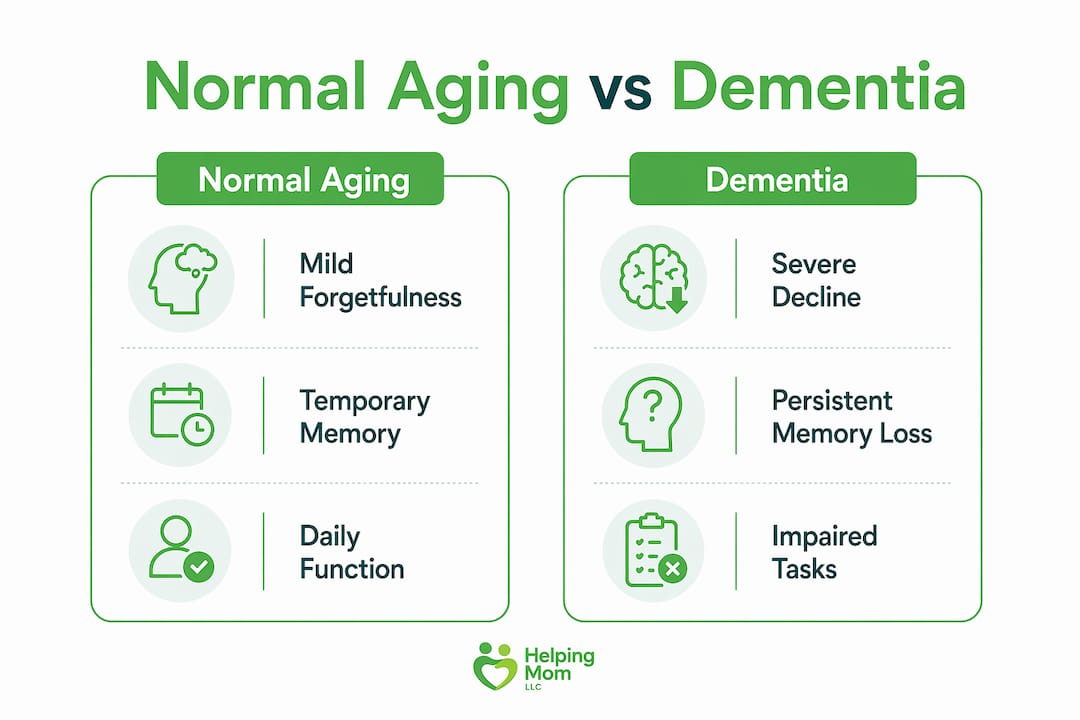
Dementia causes severe cognitive decline that interferes with daily tasks like shopping, cooking, and managing money. That is the clearest line between the two. Normal aging slows things down a little. Dementia takes things away.

The core symptoms of dementia go well beyond memory. According to NINDS, they include memory loss of recent events, poor judgment, confusion about time or place, difficulty with language, and changes in social behavior or personality. These symptoms worsen over time and begin to affect safety and independence in ways that normal aging simply does not.
The table below shows the practical difference between normal aging and dementia warning signs:
| Situation | Normal aging | Dementia |
|---|---|---|
| Forgetting a name | Recalls it later | Cannot recall it at all |
| Misplacing items | Retraces steps and finds them | Puts items in unusual places, cannot find them |
| Getting lost | Occasionally confused in new places | Gets lost in familiar neighborhoods |
| Judgment | Occasionally makes a poor decision | Consistently shows poor judgment or risky behavior |
| Daily tasks | Slower but completes them | Cannot complete familiar tasks like making coffee |
| Mood | Occasional irritability | Persistent withdrawal, suspicion, or personality shifts |
One concept worth knowing is mild cognitive impairment, or MCI. MCI involves noticeable decline without loss of independence, placing it between normal aging and dementia. A person with MCI may struggle more than expected for their age, but they can still manage their daily life. Not everyone with MCI develops dementia, but it is a signal worth monitoring closely with a doctor.
Dementia also involves more than memory loss. Judgment, behavior, language, and safety risks are all important cues. A parent who stops paying bills, gives away large sums of money, or leaves the stove on repeatedly is showing signs that go beyond forgetting a name.
Early documentation of functional disruptions aids early recognition and caregiving planning. The signs below are the ones caregivers most commonly notice first, often before a formal diagnosis is made.
Watch for these specific red flags:
Repeating questions or stories.
Asking the same question three times in one conversation, with no memory of having asked before, is a meaningful pattern.
Forgetting recent conversations.
Not just forgetting details, but having no memory that a conversation happened at all.
Getting lost in familiar places.
Driving to the grocery store they have visited for 20 years and not knowing how to get home.
Trouble with language.
Stopping mid-sentence, substituting odd words, or struggling to follow a simple conversation.
Poor decision-making.
Falling for phone scams, giving money to strangers, or making unsafe choices around the home.
Inability to complete familiar tasks.
Forgetting how to make a recipe they have cooked for decades, or not knowing how to use the television remote.
Mood and behavior changes.
Becoming withdrawn, suspicious of family members, or unusually irritable without a clear cause.
The difference between a one-time lapse and a pattern matters enormously. Repeated, progressive, and out-of-character changes are more indicative of dementia than isolated incidents. A single bad day is not a diagnosis. A consistent pattern of worsening over weeks or months is a reason to act.
Alzheimer's Research UK advises tracking symptom frequency, progression, and interference with daily function to distinguish dementia from normal lapses. That practical habit, writing down what you observe and when, gives a doctor far more to work with than a general sense that "something seems off."
Pro Tip
Use a simple notes app on your phone to log specific incidents with dates. After two or three weeks, patterns become much clearer, and you will have something concrete to share at a medical appointment.
Supporting your parent well starts with knowing what you are actually dealing with. If the changes you observe are within the normal range, the goal is to support independence without creating unnecessary worry. If the changes suggest something more serious, the goal shifts toward getting a professional evaluation and planning ahead.
Here are practical steps that fit both situations:
Schedule regular health check-ups.
A primary care doctor can screen for cognitive changes and rule out reversible causes like vitamin B12 deficiency, thyroid problems, or medication side effects. These are more common than most families realize.
Use reminders and routines.
Pill organizers, posted schedules, and consistent daily routines reduce the cognitive load for anyone experiencing age-related slowdowns.
Make the home safer.
Reducing fall risks, improving lighting, and removing clutter supports independence regardless of cognitive status. Helping-mom's home safety guide for seniors walks through this room by room.
Communicate with care.
When you raise concerns with your parent, frame it around what you have observed, not what you fear. "I noticed you seemed confused about the appointment last week" lands very differently than "I think you have dementia."
Involve siblings and family early.
Sharing observations with other family members prevents misunderstandings and helps everyone respond consistently. A structured family meeting for aging parents can make these conversations much easier.
Know when to ask for a referral.
If a primary care doctor's screening raises questions, ask for a referral to a neurologist or geriatrician who specializes in memory and aging.
Caregivers often mistake dementia symptom progression for stress, and that delay costs time.
Functional decline, not isolated forgetfulness, is the signal that warrants a professional evaluation. If your parent can no longer manage tasks they handled independently for decades, that is the threshold.
The clearest way to distinguish normal aging from dementia is to ask one question: does this change interfere with your parent's ability to live independently?
Slower processing and occasional forgetfulness do not disrupt daily independence.
Symptoms like poor judgment, language loss, and confusion interfere with daily tasks.
Mild cognitive impairment shows noticeable decline but preserves independence.
Repeated, worsening, out-of-character changes are the real red flag to track.
Vitamin deficiencies, thyroid issues, and medications can mimic dementia symptoms.
Most adult children I hear from describe the same experience. They noticed something small, told themselves it was just aging, and waited. Sometimes that was the right call. Sometimes it was not. The hard part is that normal aging and early dementia can look almost identical in the beginning.
What I have come to believe is that the goal is not to diagnose your parent. That is a doctor's job. Your job is to observe carefully, document honestly, and ask good questions. Framing cognitive changes as "What could be causing this?" rather than "Is this dementia?" opens the door to screening for treatable contributors beyond Alzheimer's disease. That shift in framing changes everything.
The families who handle this best are not the ones who caught every sign early. They are the ones who stayed calm, kept talking to each other, and got professional input before a crisis forced their hand. Small, consistent observations over time are worth more than one panicked conversation after a bad week. You do not need to have all the answers. You just need to keep paying attention and know where to turn when the picture becomes clearer.
Mike
Founder, Helping-mom
When cognitive changes raise questions about safety at home, having the right resources makes a real difference. Helping-mom offers practical, non-clinical guides built specifically for adult children in your position.
Support your parent's independence while reducing everyday risks at home.
A room-by-room walkthrough of home safety improvements.
Help your family think through next steps without pressure.
These resources are free, practical, and written for families, not medical professionals.
Normal aging brings mild cognitive slowdowns that do not disrupt daily life. Dementia causes severe decline that interferes with independence, safety, and routine tasks.
Normal age-related forgetfulness does not automatically lead to dementia. Mild cognitive impairment (MCI) is an intermediate stage that warrants monitoring, but not everyone with MCI develops dementia.
The earliest signs include repeating questions, forgetting recent conversations entirely, getting lost in familiar places, and showing poor judgment in financial or safety decisions.
Yes. Vitamin B12 deficiency, thyroid problems, and certain medication side effects can all mimic dementia symptoms and are treatable with early diagnosis.
Seek an evaluation when cognitive changes are disrupting daily independence, worsening over time, or clearly out of character for your parent. A primary care doctor is the right first call.