Discover essential safety tips for managing vision changes in older adults. Learn when to seek help and how to make homes safer.

One day your mom asks you to read the label on a can because the print suddenly seems smaller than it used to. Or your dad quietly admits he doesn't like driving after dark anymore.
Those moments can feel unsettling. You may notice unopened mail piling up, dishes left in the sink because they were difficult to see, increased bruises from bumping into furniture, or your parent asking you to read labels they never struggled with before.
The good news is that many vision changes are a normal part of aging. Others need prompt medical attention. Knowing the difference can help you protect both your parent's eyesight and their independence. For slower changes, focus on two things right now: schedule a complete eye exam and make a few quick safety adjustments at home.
TL;DR
Act now:
Sudden floaters, flashes, or vision loss → call 911 or go to an emergency eye clinic immediately
Book a dilated eye exam with an ophthalmologist or optometrist
Add a night light to the hallway and clear any loose rugs or cords from walking paths
Most eyesight changes in seniors are gradual, and many of the safety steps you can take are non-medical, low-cost, and effective starting today. Helping an aging parent with vision loss doesn't require becoming an expert overnight. There's no need to panic. There is good reason to act.
Some symptoms are genuine emergencies. Knowing which ones matter can protect your parent's sight.
As a caregiver, you might notice things your parent hasn't mentioned: they've stopped reading the newspaper they used to love, they're hesitant on stairs, or they reach for objects and miss on the first try. These everyday observations are worth paying attention to — they're often the earliest clues that something has changed with their elderly eyesight.
If your parent says the TV looks like it's covered in cobwebs, or they're seeing a shower of new dots, that's different from the occasional floater. Sudden floaters with flashes can signal a retinal tear or detachment.
Brief streaks or sparks in the corner of vision, especially in a dark room, need same-day evaluation.
Vision loss in one or both eyes — even if it passes quickly — should be treated as urgent.
Loss of side vision can indicate advanced glaucoma and needs urgent evaluation.
Because corneal sensitivity decreases with age, visible redness or watering can be the only outward sign. Report these even if your parent says they feel fine.
New double vision, especially with other symptoms, warrants urgent care.
Do this now:
For any of the above, call 911, go to an emergency room, or contact an eye care clinic for same-day urgent evaluation. Do not wait to see if it improves.
Many changes are a predictable part of getting older. Others point to conditions that need treatment.
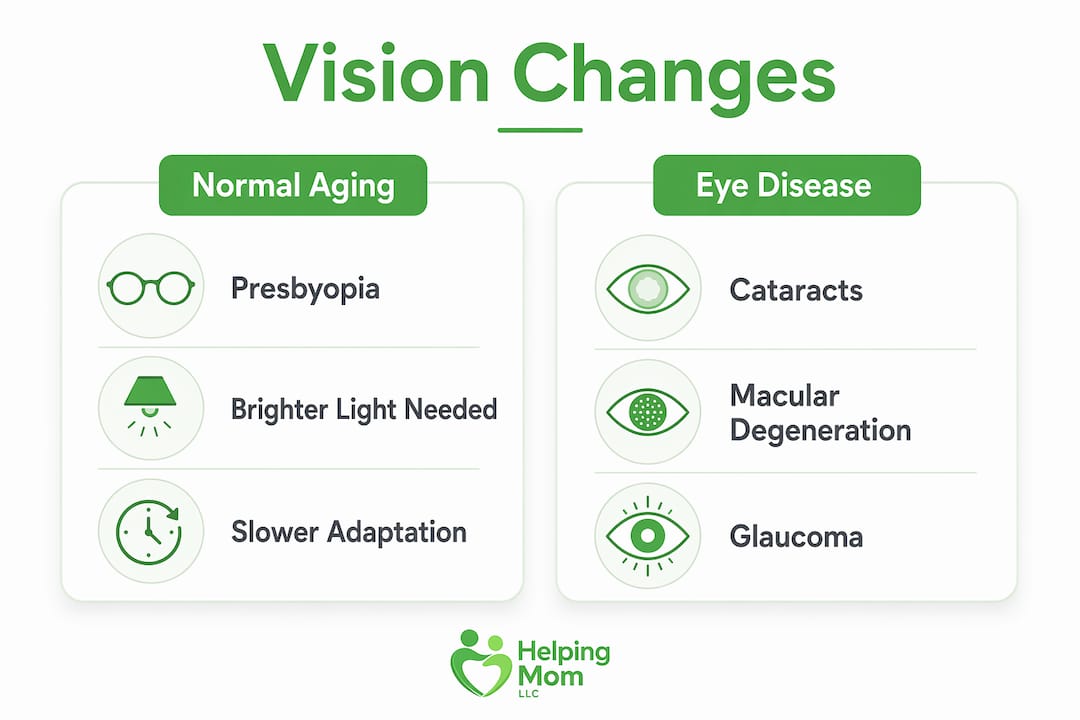
These include presbyopia (the gradual loss of near-focus ability that makes reading glasses necessary), reduced contrast sensitivity, slower light-dark adaptation, and slightly drier eyes. Your parent may need more light to read, struggle to see the edge of a step in dim light, or take longer to adjust when moving from a bright room to a darker one. These are real challenges, but they're manageable. Remember that "normal aging" doesn't mean ignoring the change — it simply means adapting with better lighting, updated glasses, and regular eye care.
Cataracts, AMD, glaucoma, and diabetic retinopathy are conditions, not just aging. AMD is a leading cause of vision loss in Americans 65 and older. Glaucoma is sometimes called a "silent" disease because most people notice nothing until the optic nerve is already affected.
Vision loss is not inevitable or untreatable. Many conditions respond well to early intervention, and even when vision cannot be fully restored, low-vision tools and home adjustments make a significant difference.
| Expected aging change | Concerning symptom | Recommended caregiver action |
|---|---|---|
| Needs brighter light to read | Blurry central vision or blank spots | Schedule eye exam; mention AMD risk |
| Slower to adjust from bright to dim | Sudden loss of side vision | Urgent eye evaluation for glaucoma |
| Occasional single floater | Shower of new floaters or flashes | Emergency eye care, same day |
| Colors seem slightly muted | Straight lines look wavy or bent | Urgent evaluation; possible AMD |
| Drier, slightly irritated eyes | Visible redness or watering | Report to eye care provider |
Simple environmental adjustments are among the most effective tools you have as a caregiver. They cost little and work immediately.
Replace dim bulbs with brighter ones throughout the home, especially in kitchens, bathrooms, and stairwells.
A bright, adjustable lamp near the reading chair makes a noticeable difference for presbyopia and low contrast sensitivity.
Older eyes scatter light more, creating glare. Soft-white or warm LED bulbs reduce this.
Brightly colored tape (red or orange) on step edges helps your parent see where one step ends and the next begins.
A small red night light gives a visible target when your parent wakes at night with unadjusted eyes.
Remove loose rugs, cords, and low furniture from main walking routes.
Avoid patterned rugs or flooring with busy designs. As eyesight changes in seniors, these patterns can sometimes be mistaken for steps or uneven surfaces, increasing fall risk.
Reaching up or bending down for items is harder when depth perception is reduced.
Pro Tip
Place a brightly colored mat in front of the bathroom sink and a contrasting-color toilet seat cover. These two changes alone help your parent orient themselves quickly in a low-light environment.
For a full room-by-room checklist, the elderly home safety checklist at Helping-mom covers lighting, flooring, and furniture placement in one printable guide.
Many inexpensive tools restore usable function for daily tasks. Start with what your parent struggles with most.

A handheld magnifier works well for mail and labels. A stand magnifier is better for longer reading sessions. Large-print labels on medication bottles and cupboards reduce confusion and errors.
Motion-activated night lights in hallways and bathrooms turn on automatically. High-contrast dishware helps at mealtimes. See technology for aging parents for more ideas.
Label pill organizers with large print or colored stickers. A talking watch or phone reminder handles daily schedules without requiring good near vision.
Most smartphones have built-in accessibility settings that increase text size, enable voice commands, and read notifications aloud. Alexa or Siri reminders handle daily schedules without requiring good near vision. Kindle's large-print settings and television closed-caption size adjustments make a surprising difference in daily comfort. Setup for each takes about ten minutes.
Quick wins: Talking prescription readers, large-print remote controls, and colored stickers for appliance buttons are inexpensive tools that help your parent stay independent with senior vision problems.
Night driving is often one of the first activities older adults begin avoiding because changing vision makes it more stressful. Reduced contrast sensitivity and slower light adaptation make it harder to see pedestrians, read signs, and react to headlight glare, even when daytime vision seems fine.
Signs driving may be risky include new dents or scrapes, difficulty reading road signs, complaints about headlight glare, near-misses your parent mentions casually, or a pattern of avoiding driving after dark.
"I've noticed you've been skipping your evening errands. I want to make sure you stay safe and still get where you need to go. Can we talk about what's been feeling harder?"
Focus on solutions, not restrictions. This framing opens a door rather than closing one.
Good documentation turns vague worries into useful information for an eye care provider. Keep a simple log.
Don't rely on memory. Small changes that happen over several months — like needing brighter light or holding things closer — are surprisingly easy to forget by the time the appointment arrives. Write it down, even if it seems minor.
Date and time of the observation
What you or your parent noticed (describe it plainly: "said the center of the TV looked blurry")
What triggered it (bright light, reading, waking up)
How long it lasted
What activity it affected (reading, walking, driving)
Any photos if safe and relevant (e.g., a photo of the environment where a fall occurred)
Sample log entries:
"March 3 — Mom said she couldn't read her mail without holding it at arm's length. Has been happening for two weeks. Affects reading and pill labels."
"March 10 — After gardening, Dad said he suddenly saw many small dots floating. Lasted about 20 minutes. He seemed shaken."
For appointments, bring the medication list, written symptom log, current glasses, and a note about any recent falls or driving incidents. Ask specifically about contrast sensitivity and night vision. Bringing a family member helps ensure nothing is missed.
For red-flag symptoms, seek urgent care the same day. For everything else, adults over 65 should have a complete eye exam every one to two years, and more often with diabetes or high blood pressure. A dilated eye exam is the standard: the provider uses drops to widen the pupil and check the retina and optic nerve. It's painless and takes about an hour.
Routine eye exams can also detect signs of systemic conditions like diabetes and high blood pressure before other symptoms appear, and they can connect your parent to low-vision rehabilitation services when needed.
Talk with your parent's eye care provider about whether specific supplements like those studied in the NEI's AREDS2 research are appropriate for your parent's specific situation. Always confirm with a professional before starting any new supplement.
Most senior vision problems are manageable with the right combination of timely exams, simple home adjustments, and consistent observation. Helping an aging parent with vision loss is something you can do — one practical step at a time.
| Point | Details |
|---|---|
| Know the red flags | Sudden floaters, flashes, or vision loss require same-day urgent eye care. |
| Annual exams are non-negotiable | Adults over 65 should have a complete eye exam every one to two years, and more often with diabetes or high blood pressure. |
| Lighting and contrast prevent falls | Brighter bulbs, step-edge tape, and night lights reduce fall risk caused by contrast sensitivity loss. |
| Track changes before appointments | A simple log with dates, descriptions, and triggers makes medical visits far more productive. |
| Helping-mom supports the whole process | Printable safety checklists, Zoom consultations, and in-person home assessments to help you act on what you've learned. |
One of the most common patterns is adult children attributing a parent's behavioral changes to mood or memory when vision is actually the cause. A parent who stops reading the newspaper, avoids evening outings, or seems confused in unfamiliar places may simply be struggling with low-light adaptation or contrast sensitivity. These aren't personality shifts — they're practical responses to a changed sensory experience.
When you bring up vision concerns, lead with observation, not judgment. Instead of "I think your driving is getting dangerous," try "I've noticed you seem less comfortable driving at night. I want to help figure out what's going on."
Helping Mom was created because so many adult children find themselves learning these things as they go. You don't have to become an expert overnight. Sometimes having a practical plan — and someone to walk through it with you — makes all the difference. A Zoom consultation walks you through your parent's specific situation, room by room, and results in a prioritized list of changes you can actually implement. For families in Central Florida, in-person home safety assessments are available.
This article provides general caregiving information and is not a substitute for professional medical advice. Always consult a qualified eye care provider for diagnosis and treatment guidance specific to your parent's situation.