
Discover what is caregiver guilt and learn effective strategies to manage it. Find peace of mind while caring for your loved ones.
More than half of family caregivers report feeling guilty, even when they are doing everything they possibly can. 59% of caregivers experience guilt as a regular emotion, according to a 2025 survey. If you have ever driven home after visiting your parent and replayed the conversation in your head, wondering whether you should have stayed longer, said something differently, or done more, you are not alone.
This article will help you understand what caregiver guilt is, why it happens, and what you can do to manage it in a way that protects both you and the person you care for.
Most caregivers feel guilt even when doing their best, so you're not alone if you experience it.
Holding yourself to an impossible standard fuels guilt; balance effort with what you can truly control.
Unchecked guilt can lead to burnout and emotional distress—early recognition helps prevent this.
Practical steps like boundary setting, self-compassion, and support can reduce guilt's impact.
Now that we know how widespread this feeling is, let's clarify exactly what caregiver guilt means and why it's so pervasive.
Psychology Today describes caregiver guilt as the persistent feeling that you are not doing enough for a loved one, even when you are already putting in substantial effort. This is not a fleeting regret after a bad day. It becomes a quiet undercurrent that follows you through work meetings, grocery store runs, and even the moments when you finally sit down to rest.
"Caregiver guilt doesn't mean you're failing. It usually means you care so much that your standards for yourself exceed what any human being could realistically provide."
This kind of guilt shows up in recognizable ways. You may feel it when you take an afternoon off and try to enjoy yourself, only to feel selfish for doing so. You may feel it when your parent asks for something you cannot fix, or when their condition does not improve despite your best efforts. A 2025 survey confirms guilt was reported by 59% of caregivers, making it one of the most common emotional experiences in caregiving. Yet many caregivers carry it silently, believing it reflects a personal flaw rather than a very normal response to an incredibly demanding role.
Understanding coping with caregiver guilt starts with naming the feeling clearly. It is real, it is common, and it does not mean you are doing something wrong.
Understanding the definition is important, but to get a handle on guilt, it helps to know what feeds it day to day.
The most significant driver of caregiver guilt is the gap between what you expect of yourself and what is actually possible. Psychology Today notes that guilt can persist even without any real wrongdoing, because caregivers often blur the line between responsibility and control. You feel responsible for your parent's comfort, safety, and happiness, but you cannot fully control any of those things. That disconnect is where guilt takes root.
| Idealized expectation | Real-world reality | What you can control |
|---|---|---|
| Always being available | You have a job, family, and your own health | Your availability within limits you set |
| Keeping your parent happy | Mood and health change regardless of your effort | Your consistency and presence |
| Managing everything alone | Caregiving requires a team | Who you ask for help |
| Preventing all health decline | Aging is a natural process | Preparing a safe environment |
| Knowing all the right answers | No caregiver has all the answers | Staying informed and asking questions |
This table highlights something many caregivers struggle to accept: the list of things you can actually control is much smaller than the responsibility you feel carrying around in your head every day.
Understanding caregiver burden and stress often begins here, with the weight of expectations that were never realistic to begin with. The same applies to the question of setting healthy boundaries. Boundaries are not a way of doing less. They are a way of doing the right things more sustainably.
Try separating your effort from the outcome. Ask yourself: "Did I do my best with what I had today?" If yes, that is success, regardless of how the day turned out. Your parent's health trajectory does not define your worth as a caregiver.
But why does it matter? Let's look at how this guilt can silently affect both your mind and your health.
Guilt does not just feel uncomfortable. Over time, it wears on you in concrete, measurable ways. When you carry a persistent sense of not being enough, your body and mind respond. You sleep less. You withdraw from friendships. You keep pushing through exhaustion because slowing down starts to feel selfish.

Healthline recommends coping strategies that address both the emotional and physical dimensions of guilt, specifically self-compassion, realistic boundaries, and seeking outside support. These strategies exist because the impact of unchecked guilt can build into something much heavier over time.
This cycle is worth paying close attention to. Recognizing caregiver burnout often starts with noticing these quieter signs before they escalate into something harder to recover from. Learn about managing caregiver stress and the importance of self-care for caregivers.
| Emotional symptom | Physical sign | Social impact |
|---|---|---|
| Persistent guilt or shame | Fatigue that sleep does not fix | Withdrawing from friends |
| Anxiety or dread | Headaches, tension, digestive upset | Less time with partner or children |
| Feeling inadequate | Getting sick more often | Avoiding social invitations |
| Numbness or detachment | Changes in appetite | Feeling isolated or unseen |
"Taking care of yourself is not a luxury in caregiving. It is one of the most important things you can do for the person you are caring for."
Caregiver emotional support is not a nice-to-have. It is a genuine necessity. When your emotional reserves run dry, your capacity to show up for your parent shrinks with them.
Knowing the effects is the first step, but let's get practical about what really helps lift the burden of guilt.
The good news is that caregiver guilt responds well to intentional strategies. You do not have to wait until you feel better to start. Small shifts in how you think and act can interrupt the guilt cycle and gradually loosen its hold on you.
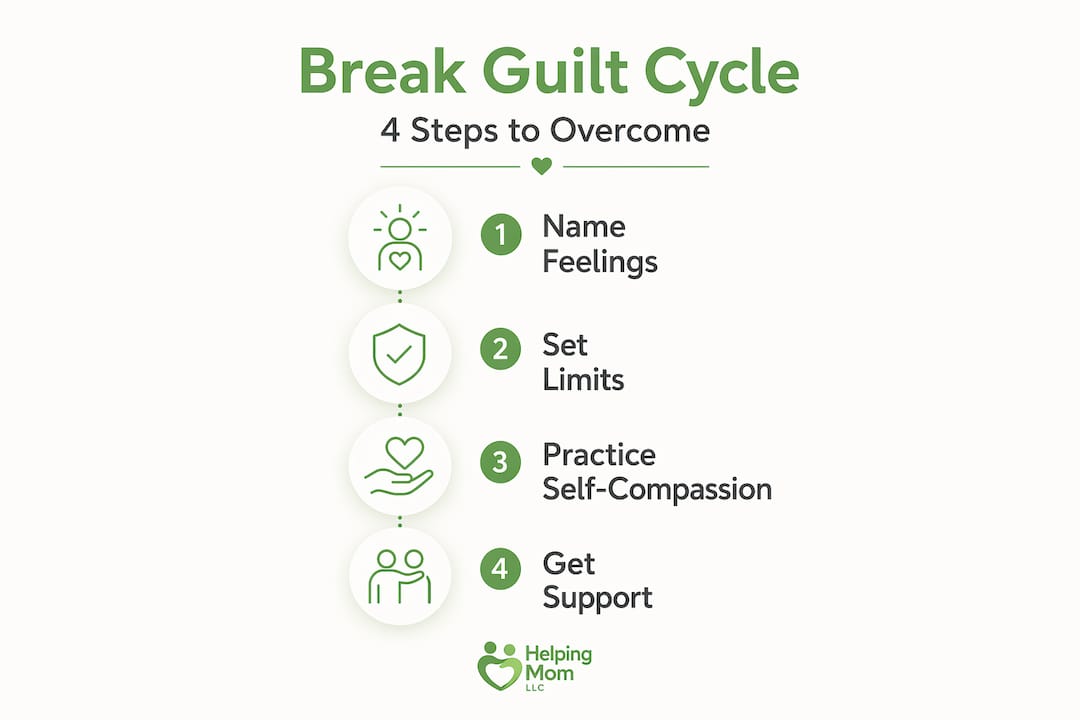
Healthline's guidance on caregiver guilt highlights several approaches that genuinely help: acknowledging your feelings, practicing self-compassion, setting realistic boundaries, and asking for help from others or professionals. These are not abstract ideas. They are practical actions you can start today.
Simply saying "I feel guilty right now" to yourself or someone you trust takes away some of its power. Guilt grows in silence. The longer you carry it alone, the more convincing it starts to sound. Naming it interrupts that process.
When guilt speaks, it often sounds absolute: "I should have stayed longer," or "A better child would not have taken that break." Ask yourself whether the story is actually true, or whether it is a standard you would never hold a friend to.
You do not have to overhaul everything at once. Choose one area where you can set a clearer limit. Maybe it is committing to one evening per week that is yours. The setting boundaries guide at Helping Mom walks through this process step by step.
Asking a sibling to cover a visit, or arranging respite care for an afternoon, is not abandonment. It is smart, sustainable caregiving. The people who love your parent want to help. Let them.
This could be as simple as writing one sentence at the end of the day that acknowledges something you did well. It retrains your inner voice over time.
If the guilt feels heavy and persistent, talking with a counselor or joining a caregiver support group can make a significant difference. You can find practical tips for coping with guilt and resources for emotional support that fit where you are right now.
Respite care is not giving up. It is refueling. Even a few hours away from caregiving gives you the space to come back more present, more patient, and more capable. Think of it as an investment in the quality of your care.
Even with tactics in hand, it helps to step back and see caregiver guilt from a wider lens.
Here is something worth sitting with: guilt is not proof that you are failing. It is almost always evidence that you care deeply and that you take your role seriously. In many cases, guilt shows up because you care deeply and want to do right by someone you love.
That said, guilt left unaddressed does not stay quiet forever. It tends to grow. It can shade into resentment, then exhaustion, then a kind of numbness that makes caregiving feel mechanical rather than meaningful. 59% of caregivers experience guilt, which means it is best understood as a common emotional response to an extraordinarily demanding role, not as a personal failing that sets you apart from others.
A 54-year-old with a demanding full-time job and two teenage kids decided after months of exhaustion to arrange for a home health aide to come in twice a week. She felt enormous guilt the first few times she used those afternoons to rest and spend time with her kids. But within a month, something shifted. She arrived at her mother's home more present and more patient. She was less reactive. She actually enjoyed their conversations again instead of just getting through them.
The break did not make her a less devoted daughter. It made her a more effective one. Balancing your needs with your parent's care is not a form of selfishness. It is a skill, and like any skill, it improves with practice. Managing caregiver fatigue is part of what makes long-term caregiving sustainable.
The mark of a thoughtful caregiver is not that guilt never shows up. It is that you notice it, question it, and gently keep moving forward rather than letting it steer you into the ground.
If you are navigating caregiver guilt, you do not have to figure it out alone. Helping Mom offers a growing library of practical, compassionate resources designed specifically for adult children in your situation.
Find resources to recognize burnout and build resilience.
Step-by-step guides to reduce daily worry about safety.
Learn how to set boundaries without guilt.
Identify signs before they escalate into crisis.
You do not have to solve everything today. Sometimes the next right step is simply giving yourself permission to stop carrying all of this alone.

45-Page Guide
Free Download
Feeling overwhelmed by caregiver guilt? Download our free 45-page Caregiver's Resource Guide — filled with practical advice, emotional support strategies, and actionable steps to help you care for your loved one and yourself.
Your information is secure. No spam, ever.