Discover what is senior transportation and find effective options for helping your aging parent navigate appointments with ease and care.

Getting an aging parent to a doctor's appointment can quietly become one of the hardest parts of caregiving. What starts as "just a ride" often turns into scheduling conflicts, missed appointments, safety concerns, guilt, and exhaustion for everyone involved.
Understanding what is senior transportation, and which options actually fit your parent's needs, is one of the most practical steps you can take as a caregiver. This guide walks you through every major option, what to watch for, and how to make it work for your family.
| Point | Details |
|---|---|
| Senior transportation is varied | Services range from public transit to paratransit, volunteer programs, and private ride options. |
| Service levels differ significantly | Curb-to-curb, door-to-door, and door-through-door assistance are not the same and affect safety. |
| Advance booking is often required | Many programs need reservations 3 or more days ahead, so backup plans matter. |
| Missing rides affects health | Missed medical appointments can dramatically increase health risks for aging adults. |
| Start formal services early | Integrating transportation support before a crisis reduces caregiver burnout and preserves independence. |
Senior transportation refers to any organized service or program designed to help older adults get from one place to another safely and reliably. It goes well beyond a taxi ride. These services are built around the specific physical, cognitive, and scheduling needs of aging adults, and they vary widely in how much assistance they provide.
Here is a quick look at the main types of senior transportation services:
Buses and trains that are technically available to everyone but often have accessibility gaps for seniors with mobility challenges.
Federally mandated services for people with disabilities, often run alongside public transit systems. Eligibility requires a formal application.
Services like Lyft and Uber that some seniors use independently or with help from family.
Community or faith-based programs where trained volunteers drive seniors to appointments and errands at low or no cost.
Specialized rides to and from medical appointments, sometimes covered by Medicaid.
Fee-based services staffed by trained drivers who specialize in working with older adults.
One thing many caregivers do not immediately realize is how much the level of assistance varies between services. There is a meaningful difference between service levels that directly impacts your parent's safety:
If your parent has balance issues or uses a walker, that distinction is not a small detail. It is a safety question.
Senior transportation also plays a deeper role than just logistics.
For many older adults, transportation is deeply connected to dignity and independence. Losing the ability to drive can feel like losing freedom, even when safer options are available.
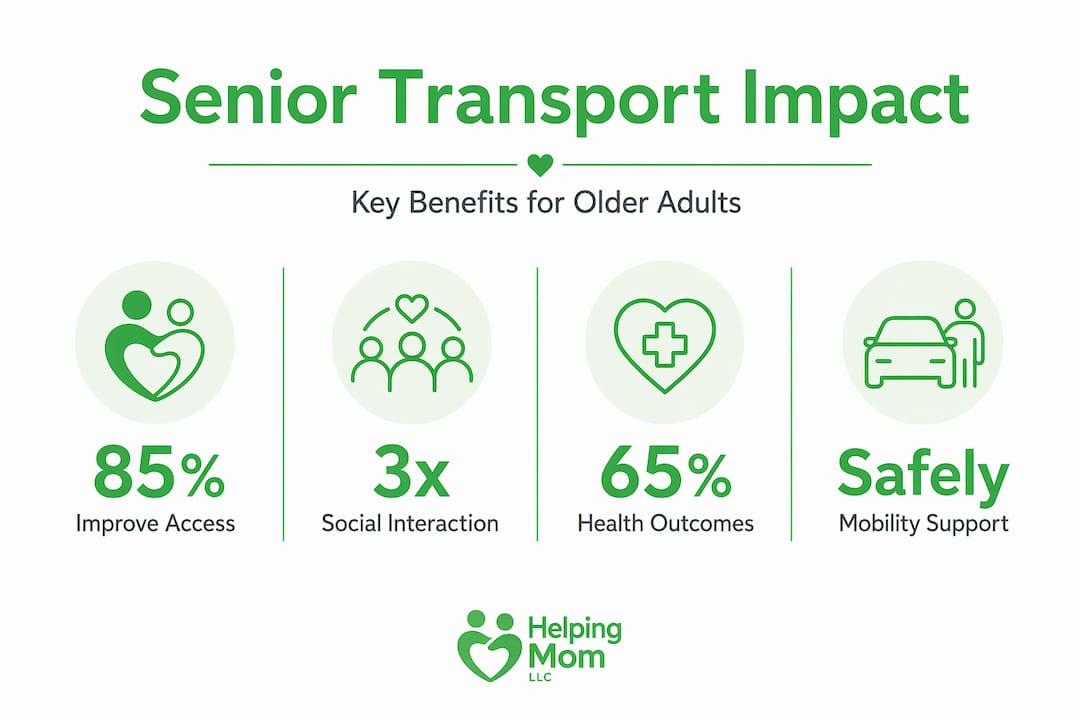
Consistent access to rides helps older adults maintain social connections, attend religious services, visit friends, and stay connected to their communities.
Pro Tip:
When researching services, ask specifically which level of assistance the driver provides. Do not assume door-to-door means the same thing at every organization.
Knowing your options is the first step to finding a good match. The right solution depends on your parent's mobility, cognitive status, where they live, and how much flexibility you need.

| Option | Cost | Assistance Level | Best For |
|---|---|---|---|
| Public transit | Low | Minimal | Mobile seniors in accessible cities |
| Paratransit | Low to moderate | Curb-to-curb or door-to-door | Seniors with documented disabilities |
| Volunteer driver programs | Free to low | Varies by program | Routine appointments, rural areas |
| Ride-hailing apps | Moderate | Minimal | Tech-comfortable seniors |
| Private senior transport | Moderate to high | Door-to-door or door-through-door | Seniors needing significant assistance |
| NEMT | Often covered | Door-to-door | Medical appointments under Medicaid |
Even good transportation services can create new stress for caregivers if families are not prepared for the limitations ahead of time.
Most programs require rides to be scheduled at least three days ahead. For routine medical appointments, that is manageable. For urgent needs, it is not. Always have a backup option ready.
Many families assume they can ride along with their parent. In practice, policies often prevent family members from accompanying a senior on specialized transportation. You may need to make separate arrangements.
Not all services that claim to be senior-friendly are equally accessible. Ask specifically whether a vehicle can accommodate a wheelchair or walker, and whether drivers are trained in transfer assistance.
Medicare generally does not cover routine transportation to doctor's appointments, though Medicare Advantage plans sometimes do. Medicaid NEMT is available for qualifying seniors.
Coordinating rides for an aging parent takes real time and mental energy. Relying entirely on informal support is one of the most common sources of caregiver burnout.
Pro Tip:
Call your local Area Agency on Aging (find them through Eldercare Locator at eldercare.acl.gov) to get a current list of subsidized transportation programs in your parent's zip code.
Health Stakes
Research from Shepherd's Center of Northern Virginia indicates that missing medical appointments increases senior mortality risk eightfold. Reliable transportation is not an optional nicety for older adults. It is connected to how long and how well they live.
Finding the right service takes a little research, but it is very manageable when you approach it step by step. Here is where to start:
One family may only need a ride to cardiology appointments twice a month. Another may need weekly grocery trips, physical therapy transportation, and help getting safely into medical buildings. The right solution depends on what daily life actually looks like for your parent.
Most senior centers keep an updated list of transportation resources in the area and can tell you what real families in your community are actually using.
Medical practices that see a lot of older patients often know which transportation services are reliable and which ones cause problems.
These publicly funded agencies exist specifically to connect older adults and caregivers with local services, including affordable senior transport options.
If your parent has a documented mobility limitation, they may qualify for subsidized paratransit service. The application process takes a few weeks, so start early.
Many churches, synagogues, and mosques run informal volunteer driver programs that are not widely advertised but are genuinely helpful.
Once you identify a few options, evaluate them on three things:
Pro Tip:
Before your parent's first ride with any new service, do a trial run for a low-stakes trip, like a trip to the pharmacy. It lets your parent get comfortable with the driver and process.
I have seen how this unfolds for a lot of families, and I want to share something I genuinely believe: most caregivers wait too long to start using formal transportation services.
What I have observed is that families almost always start with the most informal solution available, usually a son or daughter driving Mom to every appointment. And for a while, it works. But over time, that single-point-of-failure system creates pressure that quietly builds. You miss your own obligations. You feel guilty when you cannot make it. Your parent starts to feel like a burden, even when no one says it out loud. Sometimes the emotional strain grows long before anyone notices it out loud.
What I have learned is that introducing a formal service early, before there is a crisis, changes the dynamic completely. Your parent gets used to the service when they are still feeling relatively independent and capable. It becomes routine rather than a sign that something has gone wrong. And you preserve your energy for the caregiving that only you can provide.
The other thing many caregivers overlook is the assistance level question. I have talked with families who arranged what they thought was a helpful service, only to discover that the driver waited at the curb while their parent struggled with a heavy door and a crowded waiting room. Knowing whether you need curb-to-curb or door-through-door service is not a bureaucratic detail. It is the difference between a service that actually helps and one that creates new problems.
If I could offer one piece of guidance here, it is this: start the research now, even if your parent still drives. Knowing what is available in your community gives you options before you urgently need them. That kind of quiet preparation is one of the most caring things you can do.
— Mike
Senior transportation is one piece of a much larger picture. Once your parent has reliable rides, the next question is often whether the home environment itself supports their independence and safety. Helping Mom has put together practical guides specifically for families in exactly this situation.
Practical changes that make a real difference, from bathroom safety to fall prevention.
Room-by-room guidance for supporting independence and safety at home.
Articles on family conversations, caregiver wellness, and planning ahead.
Recognize the signs and have that conversation with compassion.
Caregiving often becomes a series of small adjustments made one step at a time. Reliable transportation is one of those steps. Creating a safer, calmer home environment is another. Helping Mom was built to support families through both.
Transportation challenges often tie into caregiver stress and the emotional weight of difficult conversations. Our resources address all of it.
Senior transportation includes any service that helps older adults travel safely from one place to another, including public transit, paratransit, volunteer driver programs, private senior transport companies, and non-emergency medical transportation.
Contact your local Area Agency on Aging, your parent's primary care office, or a nearby senior center. These are the fastest ways to get a current list of services available in your parent's specific community.
Standard Medicare generally does not cover routine transportation to medical appointments. Medicare Advantage plans sometimes include this benefit, and Medicaid covers non-emergency medical transportation for eligible seniors.
Door-to-door means the driver walks your parent to the entrance of a building. Door-through-door means the driver assists your parent inside, such as to a waiting room or elevator. The difference matters significantly for seniors with mobility or balance challenges.
Most senior transportation programs require reservations at least three days in advance. For urgent or unplanned needs, caregivers should maintain a separate contact, such as a volunteer driver or family member, as a backup option.
Start with a free safety guide or browse our caregiving resources to find practical support for your family's journey.