Learn when to worry about an elderly parent living alone. Recognize key warning signs, ensuring their safety and your peace of mind.
Safety concerns arise when an elderly parent's abilities no longer match their daily environment. Recognizing patterns such as frequent falls, missed medications, and hygiene decline allows timely intervention before emergencies occur. Using a structured checklist and documenting observations helps determine appropriate responses, from increased contact to professional support and home modifications.
Knowing when to worry about an elderly parent living alone comes down to one clear standard: safety is at risk when your parent's abilities no longer match the demands of their daily environment. This is what geriatric care specialists call a "functional mismatch," and it shows up in patterns, not single events. Falls, missed medications, and cognitive changes are the most common risk factors, and recognizing them early gives your family time to respond thoughtfully rather than in crisis mode. The guidance here is built for adult children who want practical, calm answers, not a list of things to fear.

The clearest signals that an elderly parent may no longer be safe living alone are changes in daily functioning, not dramatic emergencies. A single bad day means little. A pattern of bad days means something real is happening.
Watch for these signs across several weeks or months:
Pro Tip: Pay attention to repeated patterns rather than single events. One forgotten bill is nothing. Three months of unopened mail is a pattern worth acting on.
If you're not sure whether what you're seeing is normal aging or a sign that your parent needs more support, start documenting what you observe. Our free Elderly Home Safety Checklist gives you a simple way to track concerns, identify risks, and have more productive conversations with family members and healthcare providers.
Download the free checklist hereAssessing elderly safety alone requires a structured approach, not a gut feeling. Emotions cloud judgment when it comes to people we love. A graded checklist gives your family something objective to work with.
While no checklist can replace professional medical advice, a structured scoring system helps families move from vague worry to objective observation across four domains: home safety, daily living, physical health, and cognition. Here is how the tiers break down:
| Risk Level | Score Range | Recommended Action |
|---|---|---|
| Low Concern | 0–3 signs | Annual review, maintain regular contact |
| Moderate Concern | 4–8 signs | Contact your parent's doctor, increase check-in calls |
| High Concern | 9–15 signs | Request professional assessments, explore in-home support |
| Urgent | 16+ signs | Immediate intervention, consider supervised living options |
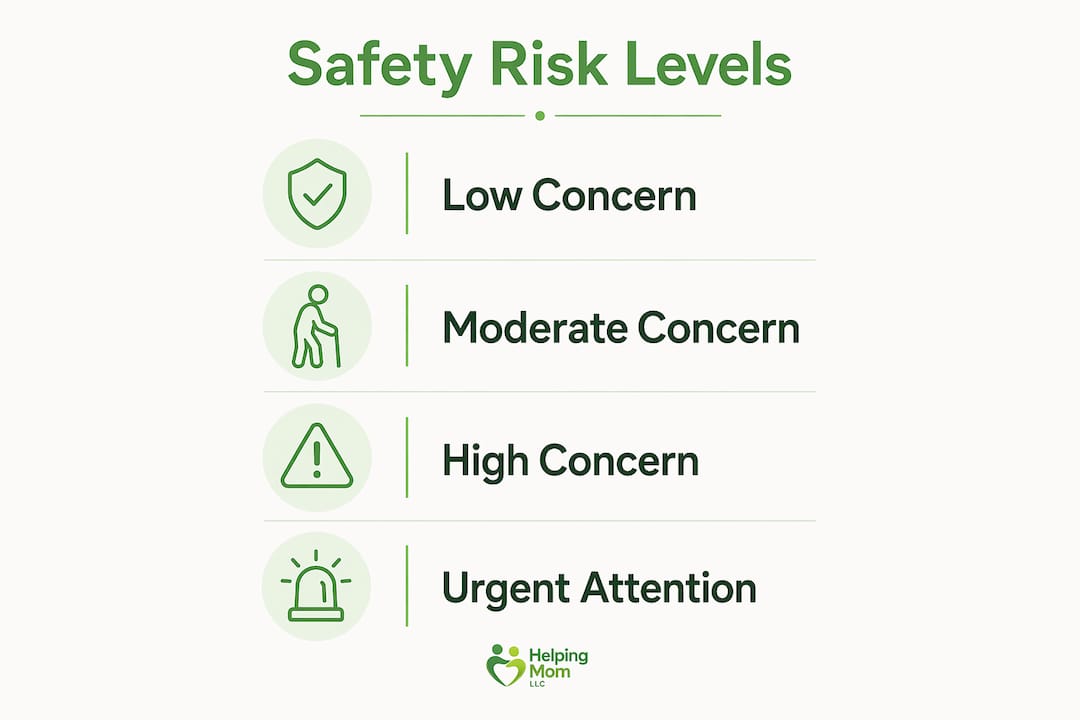
This graded checklist approach gives families a shared language. Instead of arguing about whether Mom "seems fine," you are comparing notes against the same set of criteria.
The most important habit is documentation. Building a 3–6 month observation log, where family members record specific incidents with dates, shifts family conversations from subjective worry to objective action. You stop saying "I think something is wrong" and start saying "Here are 11 documented incidents over 14 weeks."
Involving your parent's doctor is the next step at moderate or high concern levels. Ask specifically for a "medication review focused on fall risk." That exact phrase prompts a more thorough assessment than a general checkup, and it often leads to medication adjustments that reduce fall risk directly.
Pro Tip: When you call the doctor's office, use the phrase "medication review focused on fall risk." It triggers a specific clinical process that a general wellness visit may not.
You can use the free Elderly Home Safety Checklist from Helping Mom to start your observation log and identify safety concerns before they become emergencies.
Knowing when to intervene with seniors is only half the challenge. Knowing how to do it without damaging trust is the other half. The goal is to walk alongside your parent, not take over their life.
Response should match the level of concern you have documented. Here is a practical framework:
Increase the frequency of phone calls or video chats. Visit in person at least once a quarter with fresh eyes, looking for changes since your last visit.
Schedule a doctor's appointment together. Introduce one small support, such as a weekly grocery delivery or a meal service, framed as a convenience rather than a necessity.
Arrange a professional home safety assessment. Contact a local Area Agency on Aging for guidance on in-home care options. Begin a family meeting to align siblings on observations and next steps.
Consult with your parent's physician and a social worker. Explore supervised living arrangements or full-time in-home care without delay.
Home safety modifications belong at every level of concern. Proper grab bars installed into wall studs in bathrooms, improved lighting in hallways, and clutter removal from walking paths reduce hazards significantly. One critical detail: towel bars are not grab bars. They are not load-rated and will pull from the wall under body weight. Only fixtures installed into studs with proper hardware provide real fall prevention support.
When you have the conversation with your parent, use specific and compassionate language. Say "I noticed the mail has been piling up and I want to help figure that out together" rather than "I'm worried you can't manage anymore." The first opens a door. The second closes one.
Family caregiving without adequate support often leads to caregiver burnout, which can affect physical health, emotional wellbeing, relationships, and decision-making. Seeking help early protects both your parent and the family members supporting them.
Sometimes it is difficult to separate normal aging from emerging safety concerns. A professional home safety assessment can identify fall hazards, mobility challenges, lighting issues, and practical modifications that support independent living.
Helping Mom offers virtual consultations nationwide and in-person assessments throughout the Lakeland, Orlando, and Tampa areas.
Learn more about home safety assessments hereChoosing the right living situation for an elderly parent is not a one-time decision. It is an evolving one. Understanding the options helps you plan ahead rather than react in a crisis.
| Living Option | Safety Level | Autonomy | Social Interaction | Cost Range |
|---|---|---|---|---|
| Living alone, no support | Varies by ability | Highest | Depends on parent | Lowest |
| Aging in place with in-home support | Moderate to high | High | Moderate | Moderate |
| Assisted living facility | High | Moderate | High | Highest |
Aging in place with support is the option most families underestimate. In-home aides, meal delivery services, medication management tools, and home safety modifications can extend safe independent living by years. The key is matching the level of support to the level of observed risk, and adjusting as needs change.
Assisted living is not a failure. For parents with high or urgent risk scores, a well-chosen facility provides 24-hour supervision, social engagement, and structured medical support that no family can replicate alone. Many families find that their parent thrives socially in ways they did not expect.
The most important principle is fit. A parent with mild mobility issues and strong cognition may do beautifully with weekly in-home help and a medical alert device. A parent with significant memory loss and repeated falls needs a different level of support. Needs evolve, and your plan should evolve with them.
Framing additional support as a way to maintain independence, rather than surrender it, increases the chance your parent will accept help. Parents who feel autonomous in the decision are far more likely to cooperate with the plan. Starting small, such as a daily check-in call or a single weekly aide visit, eases the transition into more structured support.
For a deeper look at what aging in place really involves, the aging in place home safety guide at Helping Mom walks through practical steps families can take at every stage.
If you're unsure whether your concerns are serious enough to act on, start by documenting what you observe over the next 30 days.
Track:
Small patterns often reveal problems before a crisis occurs.
Download the free Elderly Home Safety Checklist here:
Get the ChecklistWorrying about an elderly parent living alone becomes productive when it is grounded in observable patterns, documented over time, and met with responses that match the actual level of risk.
| Point | Details |
|---|---|
| Patterns matter more than single events | Document repeated signs over 3–6 months before drawing conclusions or making major decisions. |
| Use a graded scoring system | Score observed signs across four domains to determine low, moderate, high, or urgent risk levels. |
| Match your response to the risk level | Start with increased check-ins for low concern and escalate to professional support for high or urgent concern. |
| Home modifications reduce real risk | Install load-rated grab bars, improve lighting, and remove clutter to lower fall hazards at home. |
| Caregiver burnout is a safety issue | Bringing in professional help early protects your parent's care quality and your own wellbeing. |
I want to share something I see come up again and again in conversations with adult children: the hardest part is not recognizing the signs. The hardest part is trusting what you see.
Most of us have a version of our parent in our minds that is 10 or 15 years younger. We visit, we notice something feels off, and then we talk ourselves out of it. "She was just having a bad day." "He's always been forgetful." That emotional lens is the single biggest obstacle to getting help at the right time.
What I have found actually works is separating observation from interpretation. Write down what you see, not what you feel. "Three unopened utility bills on the counter" is an observation. "I think she's struggling" is an interpretation. Observations are what you bring to a doctor or a family meeting. Interpretations are what you process with a friend.
The other thing worth saying plainly: starting the conversation early is always better than waiting for a crisis. A calm discussion about adding a weekly aide is a very different conversation from an emergency room decision about next steps after a serious fall. You have more options, more time, and more dignity to offer your parent when you act before things reach a breaking point.
This is not about taking control. It is about staying close enough to notice, and caring enough to act.
In my own work with families, I rarely see people regret acting too early. What I hear most often is, "I wish we had started paying attention sooner." Early conversations create options. Crises remove them.
— Mike
If you are trying to figure out where your parent falls on the safety spectrum, Helping Mom has practical resources built specifically for adult children in your position. The home safety guide for seniors walks through room-by-room modifications that reduce fall risk and extend safe living at home. The elderly home safety checklist gives you a structured tool to document observations and identify gaps. For families navigating difficult conversations, the guide on talking with aging parents offers calm, specific language that keeps the door open. Browse the full caregiving resource library for guides on home safety, caregiver wellbeing, and recognizing when a parent needs help. These resources are free, practical, and written without medical jargon.