A steady hand on your shoulder — not a lecture, not a list of impossible standards. Just practical support for reducing stress in small, sustainable ways.
You're answering emails between meetings, checking your phone for updates from your parent's doctor, and trying to remember whether your mom ate lunch or just said she did. Later tonight, you may need to calm repeated questions, sort out a bill, or talk with a sibling who means well but isn't helping much. None of this looks dramatic from the outside. It just feels heavy.
That heaviness is part of why caregiver stress dementia can be so hard to name. It often builds slowly. You keep showing up, solving the next problem, and telling yourself you'll rest when things settle down. But with dementia, things don't always settle down in a tidy way.
"You're not doing anything wrong. You're responding to a demanding situation that asks for patience, flexibility, and emotional stamina, often all in the same day."
If you're feeling stretched thin trying to manage everything, you're not alone. Many adult children reach this point quietly. If you need a place to begin, start with the Start Here guide for simple next steps you can take today.
You do not need a total life overhaul to feel a little more grounded. Often, the most helpful changes are modest ones. A clearer routine. A better boundary. A short break you ensure you take. A simple plan for what to do when a hard moment shows up again.
Maya noticed the change in pieces.
First it was the repeated phone calls asking what day it was. Then it was unopened mail on the kitchen table. Then a sharper edge in her father's voice when she tried to help. She still had work deadlines, kids to get to practice, and a house that needed ordinary things like groceries and laundry. Caregiving didn't arrive as one clear event. It slipped into her life little by little.
That's how it often happens for adult children. You may still be learning what your parent needs while already giving a great deal of yourself. You're trying to stay calm, make thoughtful decisions, and avoid overreacting. At the same time, you may feel grief, frustration, tenderness, guilt, and fatigue, sometimes all before noon.
Caring for a parent with dementia can feel confusing because love and strain often show up together. You may feel grateful for moments of connection and completely worn out by the constant adjustments. Those feelings can coexist.
"You can care deeply about your parent and still feel tired, impatient, or unsure. Those reactions are human, not a sign that you're failing."
Sometimes the hardest part is that there isn't one single problem to solve. There are many small demands. A missed appointment. A repeated story. A tense conversation with family. A growing sense that you're the one holding everything together.
Instead of asking yourself to handle everything perfectly, it can help to think in smaller units.
That shift matters. It turns caregiving from one giant, impossible burden into a series of manageable choices.
You're allowed to build this one step at a time.
Dementia caregiver stress is more than being busy or tired. It's the strain that comes from caring for someone whose needs, moods, memory, and abilities can change in ways that are hard to predict. Regular stress usually has a shape. You know what the problem is and what fixing it might look like. Dementia often feels more like walking a familiar path where the ground keeps shifting under your feet.

That's one reason the experience can feel so different from other caregiving roles. You may not only be helping with meals, rides, and reminders. You may also be responding to confusion, repeated questions, suspicion, wandering, or sudden anger. According to Caregiver Action Network's overview of dementia caregiver stress, approximately 40% of dementia caregivers experience depression, compared to 5 to 17% of non-caregivers in the same age group, and dementia caregivers often provide nearly 50 hours of hands-on support per week.
Part of the strain comes from a kind of grief that doesn't always have clear language. Your parent is still here, but the relationship may not feel the same. You may miss how they used to talk, plan, joke, or reassure you.
You may also be carrying a role reversal that feels unnatural. The person who once handled family decisions may now need help with things they used to manage with ease. Even when you willingly step in, that shift can stir up sadness and tension.
It helps to separate the load into categories, because "I'm stressed" can feel too vague to work with.
| Part of life | What it may look like |
|---|---|
| Emotional | Irritability, guilt, sadness, dread before calls or visits |
| Physical | Trouble sleeping, headaches, muscle tension, low energy |
| Mental | Forgetfulness, trouble focusing, decision fatigue |
| Social | Pulling back from friends, avoiding plans, feeling alone |
| Practical | Managing schedules, bills, paperwork, transportation, safety concerns |
A helpful reframe:
The intensity of caregiver stress dementia doesn't mean you're weak. It usually means the situation is asking a lot from you in many directions at once.
Many adult children get confused here. They think, "I can handle hard work. Why does this feel so destabilizing?" The answer is often unpredictability.
If your parent needed the same support every day, you could build around it. Dementia doesn't always offer that consistency. You may start the day with one plan and spend the afternoon adapting to a completely different reality. That constant adjustment takes energy, even when no one else sees it.
So if this kind of stress feels different, that's because it often is.
Many people notice caregiver stress only when they're already running on empty. Until then, it can look like "just being busy" or "just a rough week." Gentle self-awareness can help you spot strain earlier, when small adjustments are still possible.
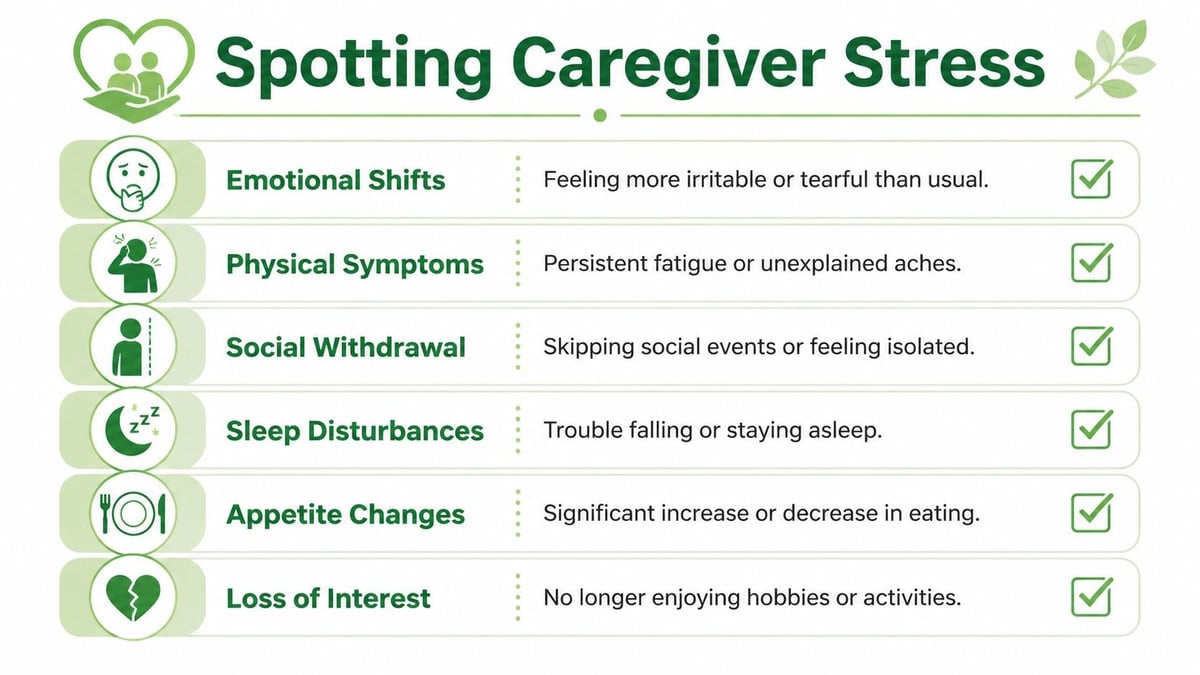
A useful reminder is that strong reactions are common in this role. In BrainCheck's article on caregiver stress and dementia, 60% of dementia caregivers report high or very high emotional stress levels, and many develop depression or anxiety during caregiving.
Stress often shows up first in the tone of your day.
Maybe you're snapping more quickly. Maybe small setbacks make you want to cry. Maybe you feel guilty after every difficult visit, even when you handled it reasonably well.
These reactions don't mean you're becoming uncaring. They often mean your emotional reserves are running low.
The body usually keeps score before the mind catches up.
You might feel tired even after sleep. You may notice jaw tension, headaches, stomach discomfort, or that wired-but-exhausted feeling at night. Some people also find that their sleep gets lighter because they're waiting for the next phone call or problem.
Your body isn't being difficult. It may be signaling that it needs steadier care from you.
Stress can subtly shrink your world.
You may turn down invitations because it feels easier to stay home. You may stop returning messages because conversation feels like one more task. Or you may be around people physically but feel too distracted to really connect.
Social withdrawal is understandable. It's also a sign that you may need support before isolation deepens.
Caregiving requires a lot of small decisions. Over time, that can wear down your mental bandwidth.
You might reread the same email several times. You may forget things you'd normally remember. Making even simple choices can start to feel oddly hard.
| Question | What it might mean |
|---|---|
| Am I having trouble focusing? | Your mind may be overloaded |
| Do small tasks feel bigger than they are? | Decision fatigue may be building |
| Am I forgetting basic things? | Stress may be affecting concentration |
| Do I feel mentally "full" all the time? | You may need fewer inputs, not more effort |
Try a one-minute check in the evening. Ask yourself three questions and jot down a few words.
You don't need a full journal. A note in your phone is enough. The goal is not to analyze yourself. It's to notice patterns before they become your normal.
When stress is coming from many directions, broad advice like "take care of yourself" can feel useless. What helps more is something small enough to do on a regular Tuesday.
One important insight can make daily coping feel less random. A study summarized in this review on dementia and caregiver burden found that caregiver stress is strongly driven by a parent's problem behaviors, such as disruptive actions and memory-related difficulties. When researchers adjusted for those issues, the gap in stress between dementia and non-dementia caregivers was nearly eliminated. In plain language, this means the strain often comes from managing difficult day-to-day behaviors, not from some personal weakness in the caregiver.
On hard days, lower the number of decisions. Pick one caregiving task, one work priority, and one personal need. That's it.
Long self-care routines sound lovely and often don't happen. Short resets are more realistic.
Sit in the car for five quiet minutes before going into your parent's home
Walk one lap around the block after a difficult call
Do ten slow breaths with your shoulders relaxed
Drink a glass of water without multitasking
Practical rule:
Don't wait until you feel calm to take a break. Take the break so calm has a chance to return.
A lot of caregiving stress comes from repeated hard moments that seem to appear out of nowhere. Writing down a few details can make those moments easier to work with.
You're not creating a formal record. You're looking for patterns. Maybe your parent gets more upset when rushed. Maybe evenings are harder. Maybe confusion spikes when there are too many people in the room.
That kind of pattern-tracking can reduce stress because you stop guessing every time.
Care tasks multiply fast when everything lives in your head. A single place for appointments, errands, refill reminders, and family assignments can reduce mental clutter.
If you want a simple starting point, this caregiver schedule template can help you organize the week without overcomplicating it. What matters is consistency, not the tool.
Sometimes the easiest way to lower stress is to reduce friction in the environment.
These aren't magic fixes. They only reduce the number of things that can go wrong at once.
If "getting help" feels too big, make it smaller.
Ask a sibling to handle one weekly task. Ask a neighbor to pick up one grocery item. Ask a friend to call you during your commute home. Small support counts. In fact, it often works better because it's specific.
You don't need to redesign your whole life this week. You just need to remove a little pressure where you can.
Boundaries can sound harsh when you're caring for a parent. In reality, healthy boundaries are often what allow care to stay loving instead of resentful. They protect your time, your energy, and your ability to keep showing up.

Research reviewed in this article on caregiver burden and coping notes that setting emotional boundaries is important for preventing resentment and guilt. It also points out that family conflict and lack of knowledge can make distress worse, while stronger social support and coping approaches can reduce the sense of burden.
Laura started visiting her mother every evening after work. At first it felt manageable. Then the visits stretched longer, dinner at home disappeared, and every request started to feel loaded. She loved her mother. She also started dreading the drive over.
What helped was not becoming colder. It was becoming clearer.
She began saying things like:
These are caring statements. They are also limits.
A parent may not like a boundary every time. That doesn't make it unkind. It makes it real.
If conversations feel tense or stuck, this guide on talking to aging parents about safety can help you approach it calmly.
If you need more examples like this, see how to set healthy boundaries.
The boundary examples above can help you get started with practical wording.
Family stress often grows in the gaps between expectations and actual help. One person becomes the default coordinator, and everyone else assumes things are under control.
Short scripts can reduce that fog.
| Situation | Boundary script |
|---|---|
| A sibling says "Let me know if you need anything" | "Thanks. Could you take over pharmacy pickups on Thursdays?" |
| A relative criticizes from a distance | "I'm open to ideas, but I need practical help more than commentary." |
| Someone ignores agreed tasks | "I need to know by Friday whether you can do this. If not, I'll make another plan." |
Boundaries work best when they are simple, specific, and repeated calmly.
Some of the hardest boundaries are internal.
You may need to stop answering non-urgent calls during meetings. You may need to leave a visit even when your parent wants you to stay longer. You may need to accept that being a devoted adult child does not mean being available at every moment.
If you want more ideas for wording and everyday limits, this guide on how to set healthy boundaries offers practical examples that many adult children can adapt.
Some caregivers try to protect work by saying nothing until they're overwhelmed. Usually, a small amount of honest planning works better.
You might say to a manager, "I'm helping support an aging parent, and there may be occasional appointment issues. I'm staying on top of my work, but I may need some flexibility on certain mornings."
One practical way to think about boundaries is this:
They are not walls against your parent. They are guardrails for your energy. And guardrails make long roads safer.
Many caregivers wait to look for support until they're already depleted. That's understandable, but it often makes the search feel harder. A calmer approach is to think about support before you're desperate for it.
Care coordination alone can take a lot out of you. In this review of dementia caregiving challenges and support needs, 70% of dementia caregivers report care coordination as highly stressful. Finding respite care is also listed as a major stressor, along with costs and coordinating with multiple doctors.

Respite care means a break in caregiving responsibility. It can be short or longer. It can happen at home or elsewhere. It does not mean you're stepping away from love or responsibility.
It may look like:
The goal is sustainability. When you get a real break, you're often more patient and more present afterward.
You don't need a perfect care plan. You need a first draft.
Write down four categories:
Under each category, keep it plain. One sibling might handle insurance calls. A neighbor might do one grocery run. A home care agency might provide short visits. An online group might give you emotional support when family can't.
If community and peer support would help, this online support group resource for caregivers can be one place to start looking at options without leaving home. Helping Mom LLC also publishes practical educational tools for adult children who are trying to organize care and plan next steps.
General help is nice. Targeted help is better.
If nights are stressful because you worry about wandering or unsafe movement, it can help to learn about simple safety tools. For example, essential bed alarm information for caregivers can help you think through one type of overnight support tool in a practical way.
If mornings are the problem, maybe the best support is not overnight care at all. It may be breakfast help, transportation, or a standing phone check-in.
Relief doesn't have to be big to be meaningful. A reliable two-hour break can change the feel of an entire week.
Different families need different kinds of help. As you research, ask:
Those questions keep you from chasing generic solutions.
Planning for support is not giving up.
It's making caregiving more realistic, which is one of the most caring things you can do.
Caregiving stress rarely disappears because of one major decision. More often, it softens because of repeated small choices. You notice your own warning signs sooner. You stop trying to carry every task alone. You build a routine that leaves a little room for your own life.
That matters.
A steady boundary, a short reset, a shared calendar, a few hours of respite. These steps may seem modest, but they can change how caregiving feels from week to week. They also protect something important: your relationship with your parent. When you have a little more energy and a little more support, it's easier to bring patience and warmth into the moments that matter.
You do not need to become a perfect caregiver. You do not need to handle every problem without help. You only need a way to keep going that is humane for both of you.
If today feels heavy, start small.
Choose one pressure point. Make one change. Let that be enough for now.
Yes. Very normal. Many adult children assume that if they were more patient or more loving, they wouldn't need time away. But breaks are part of sustainable caregiving. Wanting rest usually means you're human, not uncaring.
A helpful test is this: if a friend described your schedule to you, would you think they deserved a break? You probably would. Try offering yourself that same fairness.
Resistance is common, especially when help feels unfamiliar or threatening to independence. Start small and keep the focus on comfort, not control.
You might try one limited change at a time, such as a short visit from a helper, a meal drop-off, or help with one errand. It can also help to frame support around your needs instead of your parent's limitations. For example, "I need someone to stay with you while I'm at my appointment."
You can also read what to do when aging parents refuse help for step-by-step guidance.
Start with a direct, specific ask. Vague requests often lead to vague responses.
Instead of "Can you help more?" try "Can you call the insurance company this week?" or "Can you take Mom to her haircut on Friday?" If they still don't follow through, make plans based on what they do, not what they say they'll do.
That can feel disappointing, but it protects your energy.
Take it seriously when it starts affecting your sleep, patience, ability to work, or connection with other people. You don't need to wait until you're completely overwhelmed.
If you keep thinking "I should be handling this better," try changing the question to "What support would make this easier?" That shift is often more useful and more compassionate.
Long-distance caregiving can be stressful in a different way because you're often coordinating more than doing hands-on care. Keep information in one place, use a shared calendar when possible, and prepare short question lists before appointments or family calls.
It also helps to identify one local contact, even if it's only for occasional check-ins. Distance doesn't make you less involved. It just means your role may center more on organizing, planning, and communication.
If a small change makes the week feel even slightly more manageable, it's worth keeping. Not every solution has to be dramatic to be effective.
Look for signs like fewer rushed moments, less confusion, better sleep, or a little more patience. Those are meaningful improvements. Caregiving often becomes more workable through steady adjustments, not one perfect fix.
Helping Mom LLC offers calm, practical education for adult children supporting aging parents at home. Explore guides on boundaries, planning, communication, and caregiving decisions.