Discover calm, practical strategies for managing caregiver stress. This guide helps you find balance and support while caring for an aging parent.
The first step in managing caregiver stress is to see it for what it is—a completely normal response to a demanding role. This isn't about adding another overwhelming project to your plate. It's about taking small, intentional steps to protect your well-being so you can be a grounded, supportive presence for your parent and for yourself.
If you're feeling pulled in a thousand directions while caring for an aging parent, you are not alone. Stepping into this role is a significant life shift, and the quiet, steady pressure that comes with it is an understandable response.
This isn't a sign that you're not doing enough. It's a reflection of the enormous responsibility you've taken on. The goal isn't to pile on more tasks, but to gently recognize where this stress is coming from so you can respond with compassion and practicality.
Juggling a full-time job, your own family's schedule, and checking in on your parent's medications—does this sound familiar? It's a story many of us are living right now.
According to a report from AARP and the National Alliance for Caregiving, a striking 40% of family caregivers say their duties directly increase their stress. This feeling is a daily reality for the millions of Americans who have stepped into caregiving roles.
Many of us in our 40s and 50s are part of the "sandwich generation," where 29% support both their children and an aging parent. The emotional toll is real, with 64% reporting high emotional stress. The most important thing to take from these numbers is that you are not on this journey by yourself. Many caregivers also experience grief and fatigue as part of this journey, which is completely normal. You can explore the full report on caregiving trends to see the bigger picture.
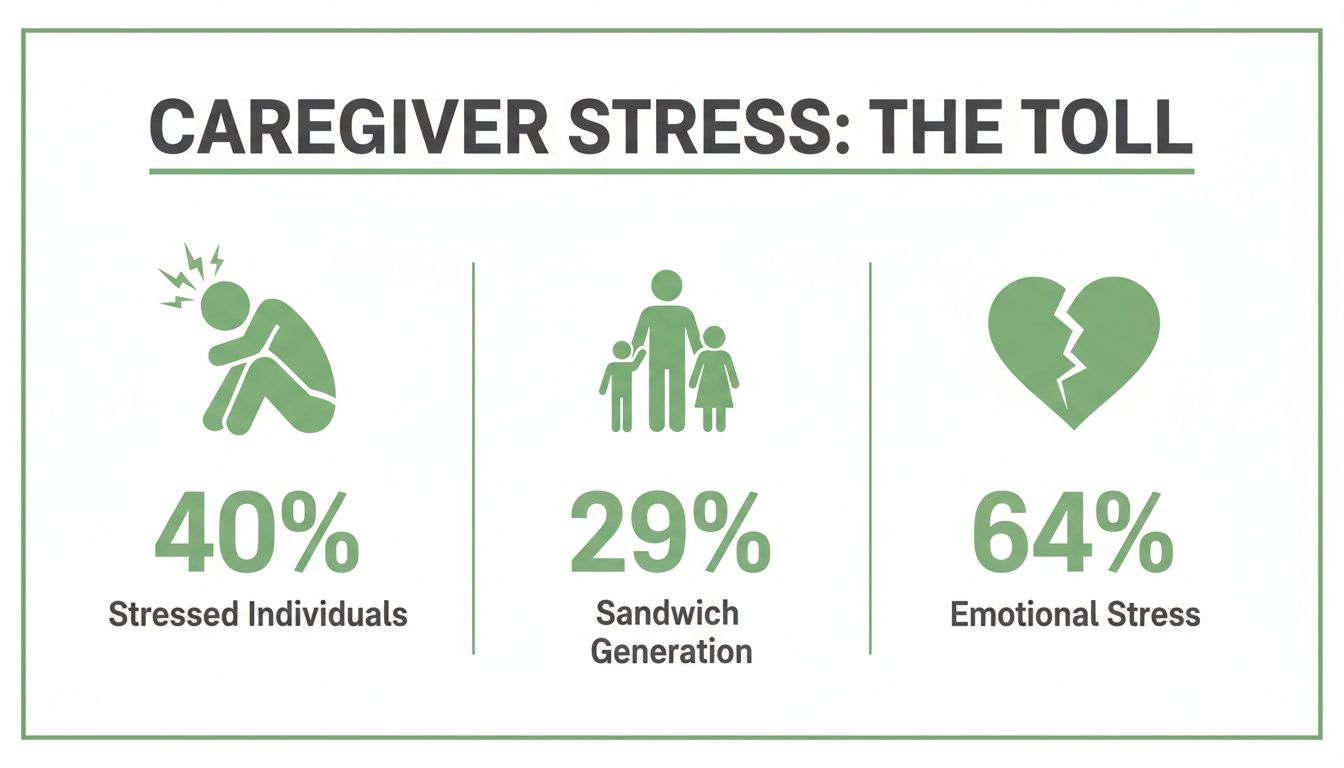
These numbers paint a clear picture. Feeling stretched thin is a common, understandable part of this journey.
Acknowledging these feelings is the first step. It allows you to move from reacting to constant demands to intentionally creating moments of stability for yourself.
Once you understand that this stress is a shared experience, you can begin to identify the specific pressure points in your own life. This self-awareness is the foundation for making small but meaningful adjustments that protect your energy, preserve your relationship with your parent, and make the path ahead feel more manageable.
Before you can manage caregiver stress, it helps to know what it looks like for you. Stress isn't always a dramatic breakdown. More often, it's a quiet hum in the background—that constant feeling of being rushed, a little less patience than you used to have, or a sense of unease you just can't shake.
This isn't about diagnosing a problem or adding another worry to your list. It's about gentle self-awareness. Learning to tune into your own signals allows you to respond with compassion before that quiet hum becomes overwhelming.
Stress shows up differently for everyone, especially when you're juggling caregiving with a career, your own family, and everything else. It often appears in subtle ways that are easy to dismiss as just being "busy" or "tired."
For instance, have you noticed that hobbies you once loved now feel like another chore? Or that you have trouble sleeping, even when you feel completely exhausted? These are common, quiet indicators that the weight of your responsibilities may be taking a toll.
Answering a simple, reflective question can be very revealing. When was the last time you felt truly rested—not just between tasks, but deeply and genuinely rested?
If you can't remember, that's a gentle sign to pay closer attention. It's an invitation to check in with yourself, without judgment.
Sometimes our bodies and minds send out signals that we're too busy to register consciously. Taking a moment to notice these patterns can be incredibly insightful.
That knot in your stomach when the phone rings late at night? You're not alone. The numbers show this is a shared experience. Research reveals that 41% of caregivers feel low overall well-being, and one in five rate their own health as fair or poor.
With one in five adults now balancing work and caregiving, the exhaustion can spill over everywhere. Physically, 45% of caregivers report high strain, while emotionally, 64% experience high emotional stress. These feelings are real and a recognized part of the caregiving journey. You can discover more insights in the latest caregiving statistics.
To help you connect these feelings to their source, take a look at the table below. It isn't a test, but a gentle tool for reflection.
This table can help connect common caregiver experiences to the underlying stress they might be signaling. It's a first step toward noticing the patterns.
| Common Caregiver Experience | What It Might Be Signaling |
|---|---|
| Feeling a constant need to check your phone for calls or texts from your parent. | A heightened sense of anxiety or responsibility. |
| Making a small mistake, like forgetting an appointment, and feeling overwhelming guilt. | The pressure of trying to be perfect. |
| Avoiding conversations with friends because you don't have the energy to explain your situation. | A sense of isolation or emotional exhaustion. |
| Realizing your own health check-ups are long overdue. | A pattern of putting everyone else's needs first. |
Just seeing these connections can be a relief. It validates what you're feeling and helps you understand that these aren't personal failings—they're the predictable outcome of a demanding role.
Recognizing these signals is an act of profound self-respect. It's the first, most crucial step toward building a more sustainable and balanced way to care—one that supports both your parent and you.

When you're already stretched thin, the idea of "self-care" can feel like just another chore. We tend to picture expensive spa days or week-long vacations—things that feel completely out of reach right now.
But what if we thought about it differently? Instead of another demand on your time, think of self-care as a practical, stress-management toolkit. This isn't about grand gestures. It's about small, sustainable actions you can weave into the life you're already living. The goal here is resilience, not perfection.
Overwhelm doesn't always arrive with a bang. More often, it creeps in during the small moments—right before you have to make a tough phone call to a doctor, or after a visit with your parent that left you feeling drained.
This is where a quick, intentional pause can make all the difference. The five-minute reset is a simple but powerful technique to ground yourself before you tackle the next thing.
These small breaks aren't about avoiding your responsibilities. They're about protecting your energy so you can handle them more calmly.
When your day is packed with tasks for someone else, it's easy to lose touch with yourself. The "one-thing-a-day" principle is a gentle way to reclaim a tiny piece of your day that is just for you.
The secret is to keep it small and realistic. This isn't about adding a time-consuming hobby. It's about finding tiny pockets of time for something that refills your cup, even just a little.
The goal isn't to find an extra hour in your day—it's to intentionally use one of the minutes you already have for yourself. It's a quiet promise to yourself that your well-being matters, too.
For instance, your one thing might be:
By committing to just one small, intentional act each day, you build a consistent habit of self-preservation. It sends a powerful signal to your brain that you are a priority, too. For more ways to get organized, you can look through our caring for aging parents checklist.
Sometimes the emotional weight of a visit with your parent lingers long after you've left. You might find yourself replaying conversations in your head or worrying about what comes next. A "boundary walk" is a physical way to create a little mental and emotional separation.
It's just a short, 10- or 15-minute walk you take immediately after leaving your parent's home. The purpose isn't exercise; it's transition.
On this walk, you intentionally shift your focus. Notice the trees, listen to the sounds around you, or just feel your feet on the pavement. It's a physical act that helps your mind process the visit and "close the door" on caregiving mode for a while, allowing you to return to your own home feeling more present.
Building this toolkit is an ongoing process of finding what works for you. Protecting your energy isn't selfish—it's what allows you to keep showing up for your loved one, and for yourself.

For many of us, this is one of the hardest parts of the journey. The idea of setting a boundary with a parent can bring up feelings of guilt. It can feel selfish, or like you're pushing them away, especially if you've spent a lifetime saying "yes" to every need.
But try to think of it this way: a boundary isn't a wall to keep someone out. It's a tool for sustainability. It's how you protect your own energy so you can keep showing up as a calm, loving, and effective caregiver for the long haul. Without boundaries, burnout becomes much more likely.
When you frame it as an act of preserving the relationship, the guilt can start to fade. This is about creating a structure that works for everyone, preventing resentment from taking root, and making sure the time you do spend together is present and positive.
One of the quickest ways to feel overwhelmed is feeling like you're always "on call." The phone buzzes with texts at all hours, the calls interrupt your work meetings, and you never feel fully off the clock. This is where a small, gentle boundary can make a huge difference.
Instead of answering every call as it comes, you could create a set time for a daily check-in. This gives your parent the comfort of knowing they'll hear from you, while giving you predictable pockets of time to focus on your own life, family, or work.
Here's a gentle way to introduce the idea:
"Mom, I love talking with you, but I'm having a hard time focusing at work when I'm worried I might miss your call. To make sure I can give you my full attention, how about I call you every day around 6 PM after I've wrapped things up? That way, we can talk without either of us feeling rushed."
This approach isn't about denying them access to you; it's about creating a reliable rhythm. It honors their need for connection while respecting your need for focus. We go into much more detail on this in our guide to setting boundaries with aging parents.
Saying "no" to a parent can feel almost impossible. But when you agree to a request that stretches you past your limit, you may be paving the road to resentment and exhaustion. The key is to learn to decline the request, not the person.
A kind "no" is almost always followed by an alternative you can offer. It shows you're still a willing partner in finding a solution, just not in that specific way or at that specific time.
Let's walk through a common scenario:
This response is clear and respectful while offering a concrete solution. It validates their need but honors your own commitments, reinforcing that your limits are about capacity and logistics—not a lack of care.
Money is already a sensitive topic, and a surprise request for financial help can add a significant amount of stress to your relationship. A boundary here isn't just about protecting your energy; it's about protecting your own family's financial well-being.
When your parent asks for money, it is perfectly okay to pause. You do not have to give an answer right away.
Try saying something like this:
"I hear you, and I understand this is a real worry. Let me sit down with my spouse tonight to look at our budget. We can talk again tomorrow and figure out a plan together. In the meantime, let's get a clear picture of all the bills that are creating this pressure."
This script accomplishes several things at once. It shows you're listening, it gives you breathing room to make a logical decision instead of an emotional one, and it reframes the issue as a problem you can solve together. By setting these simple but firm boundaries, you're not just managing stress—you're building a healthier, more sustainable way to care for your parents and yourself.

There's a quiet but immense pressure that can settle on caregivers—a feeling that you should be able to handle everything on your own. You might worry about being a burden, or maybe you just feel that since you're the primary caregiver, it's all your job.
That mindset, while completely understandable, can lead to burnout. Trying to do it all isn't a sign of strength; it's a sign that your plate is simply too full. Accepting help isn't admitting defeat. It's building a sustainable support system for both you and your parent.
Letting others in is one of the most powerful things you can do to manage your own stress. It gives your friends and family a tangible way to show they care, and it gives you the breathing room you so desperately need.
Before we get into the how, it's worth taking a moment to acknowledge why asking for help can feel so difficult. For many of us, the resistance comes from a few common places.
Do any of these feel familiar?
Recognizing these mental hurdles is the first step. They're normal feelings, but they don't have to be the final word. When you reframe delegation not as a burden on others, but as an invitation for them to contribute, it can shift your whole perspective.
One of the keys to getting good support is to make your requests specific, manageable, and concrete. A vague plea like, "I could really use some help with Mom," can feel overwhelming to the person you're asking. They don't know where to even start.
Instead, think in terms of small, individual, clear-cut tasks. When you offer someone a specific, low-commitment way to contribute, they are far more likely to say "yes" with confidence.
People genuinely want to help, but they often don't know what would actually be useful. When you make a specific request, you're not just asking for help—you're giving them a clear and simple roadmap to provide it.
Think about the little things on your weekly list that eat up time. Could a neighbor grab a gallon of milk on their grocery run? Could a sibling who works from home make a few administrative phone calls for you?
Breaking down the mountain of caregiving into smaller, delegable tasks makes the entire process feel more approachable. A great way to start is by creating a simple list to organize your thoughts and spot opportunities to ask for help.
Try using a framework like this to brainstorm who in your circle might be a good fit for different kinds of support.
| Caregiving Task | Who You Could Ask for Help | How to Make the Request |
|---|---|---|
| Picking up prescriptions from the pharmacy. | A sibling who passes the pharmacy on their way home from work. | "Hey, would you be able to swing by the pharmacy to grab Mom's refill this week? It would save me a trip after work." |
| Providing companionship for an hour. | A family friend or a neighbor who enjoys chatting. | "I know Mom loves talking with you. Would you have an hour next Tuesday afternoon to sit with her while I run some errands?" |
| Handling a specific administrative task, like paying a bill. | A detail-oriented relative who is good with finances or paperwork. | "You're so great with this stuff—would you be willing to take a look at this insurance statement for me? A second set of eyes would be amazing." |
| Dropping off a prepared meal once a week. | A friend who loves to cook or is already meal-prepping. | "If you're making your famous lasagna this week, would you be open to making a small extra one for Mom? It would help so much." |
This approach takes the guesswork out of it for everyone. You get the practical support you need, and the person helping feels good knowing they've done something truly useful. For more ideas on how to manage these responsibilities, see our practical advice on how to care for aging parents. Building this team is one of the most important things you can do for your own well-being.
While managing appointments and medications is a huge part of caregiving, the emotional side of it is often the heaviest. There's a profound sense of relief that can come when you share what you're going through with people who just get it.
You are not on this journey alone, even when it feels that way. Finding your support system isn't a sign of weakness; it's a powerful act of self-care. It reminds you that your feelings are valid and that you're part of a much larger community of people who understand.
A support system doesn't have to mean sitting in a circle in a community center (though it certainly can!). It can take many different forms, and what feels right for you might change from one week to the next.
The goal is simply to find a safe space where you can be honest about the tough days and celebrate the small wins without having to explain the backstory.
Here are a few places you might find that connection:
Taking that first, tiny step—whether it's sending a text or doing a quick online search for a group—can open up a world of much-needed support.
As you navigate this role, many questions and complicated feelings are bound to come up. Here are some of the most common worries we hear from adult children, along with some reassuring, practical perspectives.
If you're feeling overwhelmed, tired, or even a little resentful some days, that is understandable. Caregiving is a tangle of emotions. It's perfectly normal to feel deep love and satisfaction one moment, and then frustration or sadness the next.
These feelings aren't a sign that you don't care enough about your parent. They're a sign that you are a human being in a demanding situation that takes a huge amount of physical and emotional energy.
The most helpful thing you can do is acknowledge all of your feelings without judging them. It's the first step toward figuring out what you truly need.
Instead of asking, "Is this normal?" try asking, "What is this feeling trying to tell me?" More often than not, the answer is that you need more rest, someone to talk to, or just a little bit of help.
This is a question almost every caregiver asks, and the answer is a resounding no. Taking time for yourself isn't selfish—it's necessary if you want to be able to keep going. Think about the safety briefing on an airplane: you have to put on your own oxygen mask before you can help someone else.
When you're running on empty, your patience is thinner and your energy is lower. Small, consistent breaks are not luxuries. A 15-minute walk or a few chapters of a book are strategic acts of self-preservation. Prioritizing your own well-being protects both you and your parent from burnout in the long run.
It's incredibly common for aging parents to push back against the idea of getting help. They might be afraid of losing their independence, uncomfortable with a stranger in the house, or worried about the cost. The key is to approach this conversation with patience and empathy.
Try starting small. Instead of bringing up the idea of a full-time aide, maybe frame it as getting some help with a specific task they don't enjoy, like cleaning the house or doing yard work. Introducing support gradually often makes it feel less threatening and more acceptable over time.
At Helping Mom LLC, we specialize in calm, practical guidance for navigating these tricky conversations and finding solutions that work for everyone. You can find more articles and tips to support you on your caregiving journey at https://helping-mom.com.
Helping Mom provides calm, practical guidance for adult children supporting aging parents. Explore our guides and checklists for making homes safer, having difficult conversations, and caring for yourself along the way.
View Our Caregiving ChecklistLooking for more calm, practical guidance for supporting an aging parent?
Visit the Helping Mom Caregiving Resource Library to explore our full collection of caregiving guides, home safety resources, and practical checklists designed for adult children helping aging parents.
Browse the Caregiving Resource Library