
Back to Blog
Family Boundaries

A Guide to Setting Boundaries with Aging Parents

Feb 7, 2026
18 min read
Helping Mom Team
A Guide to Setting Boundaries with Aging Parents

Setting boundaries with your parents isn't about pushing them away. It's an act of love—for them and for you—that helps create a healthy, sustainable relationship for the years ahead. This process takes compassion, clarity, and a bit of courage.

Why Setting Boundaries with Parents Can Feel So Difficult

A young boy and an older man engage in conversation, promoting healthy boundaries.

It can be one of the hardest conversations to have. You want to be a loving, supportive child, but you might also be feeling drained, guilty, or overwhelmed. If you're wrestling with this, please know you're not alone. These feelings are completely normal when the dynamics of the parent-child relationship begin to shift.

The difficulty often comes from a mix of emotions that have been building for decades. As roles change, what once felt natural can now feel strained. Acknowledging this complexity is the first step toward finding a better balance.

The Role of Love and Obligation

For most of us, the desire to help comes from a place of deep love and a sense of duty. You remember the parent who took care of you, and you want to give that care back. But that sense of obligation can sometimes blur the lines between supportive help and unsustainable sacrifice.

This is the internal conflict that can make setting boundaries feel so challenging. It might feel like you're being asked to choose between your parent's needs and your own well-being.

The goal of a boundary isn't to create distance; it's to protect the relationship from the weight of resentment, burnout, and unspoken frustration. It makes space for love to flourish.

Reframing Boundaries as a Tool for Health

Thinking of boundaries as walls can make the process feel harsh. Instead, try to see them as guardrails on a bridge. They don't block the connection; they make it safer for everyone to cross. They can help prevent you from burning out while preserving your parent's dignity.

Establishing clear limits is an act of foresight. It's what allows you to keep showing up as a patient, compassionate, and present child for the long haul. A few positive outcomes can be felt almost immediately:

  • Reduced Resentment: When expectations are clear, frustration is less likely to build up quietly in the background.
  • Increased Presence: Because you aren't feeling constantly drained, you can be more fully engaged during the time you spend together.
  • Sustainable Support: Healthy limits are one of your best tools against caregiver burnout, helping ensure you can be there for the long run.

Ultimately, setting boundaries is about defining what you can give joyfully and sustainably. It's a necessary and compassionate step toward a relationship that honors both your parents and yourself.

Recognizing the Signs That Clearer Boundaries Are Needed

How do you know when something needs to change? The need for clearer boundaries with an aging parent rarely announces itself in a single, dramatic moment. It's often a slow burn—a quiet awareness that the current dynamic isn't working anymore for you, for them, or for your relationship.

The signs can be subtle. It might be a knot of tension in your stomach before you pick up the phone, or a deep exhaustion that sticks around long after a visit. These feelings are important signals, not something to feel guilty about. They're your cue to pay attention.

Gentle Questions to Ask Yourself

A quiet moment of reflection can bring a lot of clarity. This isn't about blaming your parent or yourself; it's simply about noticing what's happening inside of you.

Consider asking yourself:

  • Do I hang up the phone feeling connected and capable, or do I feel drained and resentful?
  • Are late-night or work-hour calls about non-emergencies becoming more frequent?
  • Do I feel like I'm constantly "on call," unable to truly relax or focus on my own life?
  • Is my own health—physical or emotional—starting to show the strain from our interactions?

If you're answering "yes," it doesn't mean you're a bad son or daughter. It just means the current dynamic may have become unsustainable. Recognizing this is the first step toward making things better for everyone. Getting organized with a caring for aging parents checklist can also help you pinpoint specific areas of strain.

It's Okay to Not Be Best Friends

It's also worth remembering that not every parent-child relationship needs to be intensely close to be healthy. Many families find a comfortable, natural balance with a bit more distance, and that's perfectly okay.

In fact, research suggests that for many families, a lower-conflict, more detached connection is the norm. It can be reassuring to know you're not alone if your relationship doesn't look like a Hallmark card.

Acknowledging that your well-being matters isn't selfish—it's essential. You can't pour from an empty cup. Recognizing the signs of burnout is an act of self-preservation that allows you to continue showing up with love.

These signals are your invitation to think about what a more balanced, sustainable relationship could look like. It's a chance to create a dynamic that supports your parent while also protecting your own peace of mind.

What Families Often Miss When Setting Boundaries

Many adult children believe boundaries are only necessary when a situation becomes overwhelming or confrontational. In reality, the need for boundaries often appears much earlier—long before resentment, burnout, or conflict reaches a breaking point.

Here are a few signs families commonly overlook when boundaries quietly become essential:

  • Emotional exhaustion without a clear crisis. Feeling drained, irritable, or constantly "on edge" after interactions—even when nothing dramatic happened—can signal that emotional limits are already being crossed.
  • Support becoming expectation. When help you once offered freely starts to feel assumed or demanded, the relationship may be shifting in ways that aren't sustainable.
  • Blurred roles within the family. If you've slowly moved from being a son or daughter into the role of manager, problem-solver, or decision-maker without discussion, boundaries may be missing rather than cooperation. This role shift often overlaps with broader caregiving decisions, including conversations about whether additional outside support—such as assisted living—may be appropriate.
  • Guilt driving decisions. When choices are made primarily to avoid disappointing or upsetting a parent, rather than because they align with what you can realistically give, resentment often follows.
  • Tension spreading to other areas of life. When caregiving interactions begin affecting your sleep, work, marriage, or mental health, it's a sign the current dynamic needs adjustment—not endurance.

Boundaries aren't a reaction to failure. They're a proactive way to protect relationships before strain turns into damage.

Recognizing the need for boundaries doesn't mean you've done anything wrong. It simply means the relationship is evolving—and thoughtful conversations can help guide that change with care. Planning how to talk about boundaries allows you to speak from clarity rather than frustration, keeping the focus on connection instead of conflict.

How to Plan a Boundary Conversation with Care

Once you realize a boundary is needed, the next step is planning. How you approach this conversation can make all the difference, turning a potentially difficult talk into a constructive one. The goal here is preparation, not confrontation. It allows you to walk into the discussion feeling calm and clear about what you need to say.

For many families, boundary conversations arise alongside earlier safety discussions, such as concerns about driving, mobility, or independence.

Choosing the right time and place is a simple but powerful first step. Try to avoid bringing up a sensitive topic when either of you is tired, rushed, or already stressed. A quiet, neutral setting where you won't be interrupted gives the conversation the best possible chance to succeed.

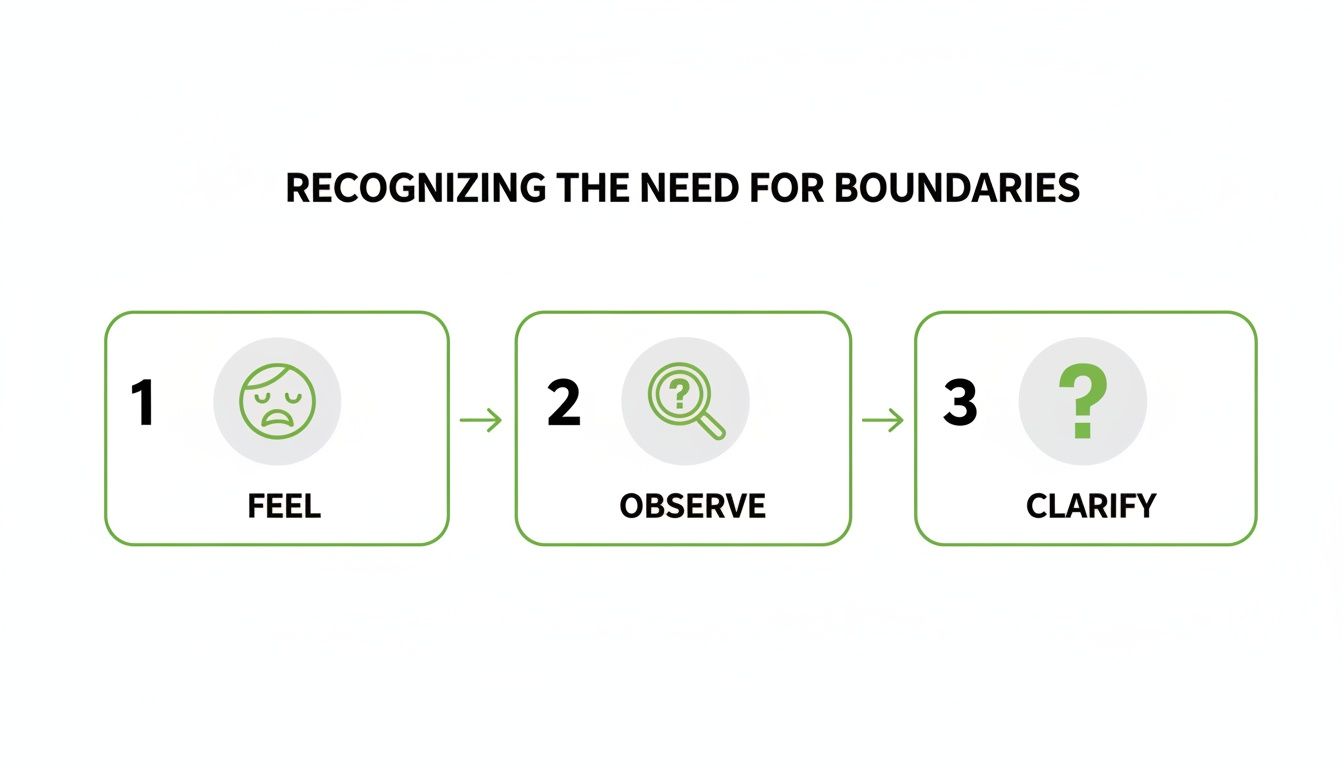
This visual guide shows the internal process of recognizing that a boundary is needed—moving from feeling drained to getting clear on what has to change.

A 3-step diagram outlining how to recognize the need for boundaries: Feel, Observe, Clarify.

This process isn't about reacting in a moment of frustration. It's a journey of self-awareness.

Create Your Boundary Blueprint

Before you say a single word, it helps to get your thoughts organized. Creating a simple "Boundary Blueprint" can help you map out what you need to communicate. Think of it less like a script and more like a guide to keep you focused and calm during the talk.

Your blueprint can cover four key points:

1

The Specific Issue:

What is the one behavior you need to address? Be precise. Instead of a vague complaint like "you call too much," try something concrete: "daily calls during my work hours."

2

The Impact on You:

How does this specific issue affect you? This is where you use "I" statements. For example, "I feel distracted at work and find it hard to focus when we talk then."

3

The New Boundary:

What is the clear, actionable limit you need to set? Keep it simple and direct. "From now on, I won't be able to answer calls between 9 a.m. and 5 p.m."

4

A Loving Reason:

Connect the boundary back to the health of your relationship. For instance, "I want our conversations to be relaxed when I can give you my full attention. Let's plan to talk in the evening instead."

This structure shifts the conversation away from blame and toward the shared goal of a healthier, more sustainable relationship. For more ideas on framing your talk in a connecting way, you might find it helpful to review some thoughtful questions to ask old people that encourage understanding.

A well-planned conversation honors your parent by being respectful and honors you by being prepared. It's an act of care to think through your words before you speak them.

When you take the time to prepare, you aren't just setting a limit. You are thoughtfully redesigning a part of your relationship so it can be more loving for everyone involved.

Choosing Compassionate Language for Your Conversation

Once you have a plan for the conversation, the focus shifts to the words you'll use. This isn't about memorizing a script. It's about choosing language that is clear and firm but also kind—words that can turn a difficult talk into a constructive one.

The goal is to communicate your needs without making your parent feel judged or blamed. When people feel attacked, their defenses can go up. By using compassionate, non-blaming language, you invite them to see your side of things instead of arguing against it.

Use "I" Statements to Share Your Experience

This is one of the most practical tools you have for setting boundaries. Shifting from "you" statements to "I" statements moves the focus from their behavior (which can feel like an accusation) to the impact on you.

For example, instead of saying, "You always call me at work and interrupt me," which can sound like a criticism, try framing it from your perspective.

"I feel really stressed when I have to juggle work calls and personal calls at the same time. To make sure I can give you my full attention, I'd love it if we could schedule our chats for after 5 p.m."

This approach doesn't assign blame. It just states your experience and offers a solution that works for everyone. It shows respect for them and for your own needs.

Choosing Your Words Carefully

A small shift from blaming language to boundary language can make all the difference. It helps your parent hear your love and concern, not just your frustration. Here's a comparison for some common situations.

Instead Of This (Blaming Language) Try This (Boundary Language)
"You can't just show up unannounced all the time." "I love seeing you! It would help me a lot if we could plan your visits so I can make sure I'm free and we can really enjoy our time together."
"You need to stop telling me how to raise my kids." "I really value your perspective, but when it comes to the kids' schedules, I feel more confident when I can make these decisions on my own. I've got it handled."
"You're always asking me for money and putting me in a tough spot." "I want to help in a way that's sustainable. Let's sit down and create a monthly budget we can both count on so there are no surprises."
"Why do you always call when I'm putting the kids to bed? You know it's a hectic time." "I love catching up with you. Evenings are just busy here. Could we try talking in the afternoon instead? I'll be much less distracted."

Notice that each of the "Try This" examples starts by reinforcing the relationship, states the need clearly and gently, and proposes a collaborative solution. It's not about being soft; it's about being strategic and loving at the same time. This approach makes it more likely your parent will hear your need instead of just your frustration.

Navigating Pushback and Gently Holding Your Ground

An older woman stands in a bright room with an open door, looking upward, next to a 'HOLD YOUR GROUND' sign.

You've had the talk and set the boundary. In an ideal world, that would be the end of it. In reality, this is often just the beginning of a new phase—one that requires patience and quiet resolve as you and your parent adjust.

It's natural to expect the boundary to be tested. It's completely normal for a parent to push back against a new limit, whether with frustration, sadness, or comments designed to make you feel guilty. This isn't necessarily manipulation; it's a human reaction to a change in a long-standing dynamic.

Your job now is to hold your ground, gently but firmly.

When your parent pushes back, your response is everything. The goal is to acknowledge how they feel without giving up the boundary you just worked so hard to establish. You can be both empathetic and firm at the same time.

"I understand this feels different, and I'm sorry it's upsetting. I love you, and this is what I need to do to make sure I can continue to be a good support for you."

This simple phrase does three things at once: it validates their emotion, reaffirms your love, and calmly restates the new reality. You don't need to over-explain or get pulled back into the same debate.

Why Consistency Is Your Best Friend

Every time you gently enforce a boundary, you're teaching your parent how you need to be treated. Every time you let it slide, you're teaching them that your limits might be negotiable. Consistency is what turns an uncomfortable change into the new normal.

This takes a quiet resilience. You may not feel strong every single time, and that's okay. Just focus on being consistent. This is especially true if you are navigating a situation where you feel your aging parents refuse help and you have to set limits on what you can realistically do for them.

Remembering You See Things Differently

Sometimes, friction comes from a simple difference in perspective. As the adult child, your priority might be safety and preventing risks. Your parent's priority, on the other hand, is almost certainly focused on maintaining their independence and sense of self.

This clash of viewpoints can be a primary source of tension.

Research from the National Center for Biotechnology Information confirms what many adult children feel instinctively: they often feel an intense sense of responsibility for their parents' health, which can lead them to want to override their parents' wishes.

Acknowledging that you and your parent are looking at the same situation from two different—and equally valid—angles can help reduce your own guilt when they resist a safety-related boundary. Responding to pushback isn't about winning an argument. It's about managing a relationship and building a healthier dynamic, one conversation at a time.

When resistance becomes ongoing or emotionally intense, learning how to respond calmly and consistently can help prevent escalation while preserving the relationship.

Common Questions About Setting Family Boundaries

Even with the best intentions, setting boundaries can feel uncertain. You might worry about hurting your parent's feelings or wonder if you're doing the right thing. These feelings are completely normal—most adult children have them.

Here are some of the most common questions we hear, along with some calm, reassuring answers to help you move forward with confidence.

What if my parent gets very emotional or angry?

Is it selfish to set boundaries with a parent who needs help?

How do I set boundaries if my parent is financially dependent on me?

My sibling disagrees with the boundaries I am setting. What should I do?

Need More Support?

At Helping Mom LLC, we provide calm, practical, and reassuring guidance to help you support your parents with confidence and compassion.