Discover key mild cognitive impairment symptoms to watch for in loved ones. Early recognition helps ensure proper support and care.

Mild cognitive impairment (MCI) involves measurable changes in memory and thinking that go beyond normal aging but do not significantly interfere with everyday independence. It sits in the space between normal age-related forgetfulness and dementia. Recognizing these early signs gives families time to seek medical evaluation, understand what may be happening, and make thoughtful plans before problems become more serious.
MCI affects about 6.7% of people aged 60–64, and that number climbs to over 25% for those aged 80–84. It's also important to remember that not every memory problem is dementia. Many medical conditions, medications, sleep disorders, depression, and vitamin deficiencies can cause similar symptoms and may be treatable.
TL;DR:
MCI shows up differently in different people, but a few patterns appear consistently. Knowing what to watch for helps you tell the difference between a bad week and something worth discussing with a doctor.
Memory and thinking changes are the most common signs. These include:
These are not the occasional slip that everyone experiences. The key difference is frequency and pattern. Your parent may notice these changes themselves and feel frustrated by them, which is actually a meaningful sign that their self-awareness is intact.
Mood and behavioral shifts are often the first thing family members notice, even before memory problems become obvious. Over 50% of cognitively normal individuals show mood symptoms like apathy or irritability before a formal cognitive decline diagnosis. That means your parent may seem less interested in hobbies they once loved, more withdrawn at family gatherings, or quicker to become anxious or frustrated over small things.

Pro Tip: Keep a simple notes app on your phone and jot down specific examples when you notice something unusual. Dates, situations, and what happened give a doctor far more useful information than a general "she seems more forgetful lately."
These behavioral changes are not personality flaws or stubbornness. They are often part of the same underlying shift in brain function. Treating them with patience, not correction, makes a real difference in how your parent feels day to day.
This is where many caregivers feel the most uncertain, and understandably so. The line between "getting older" and "something is changing" can feel blurry from the inside.
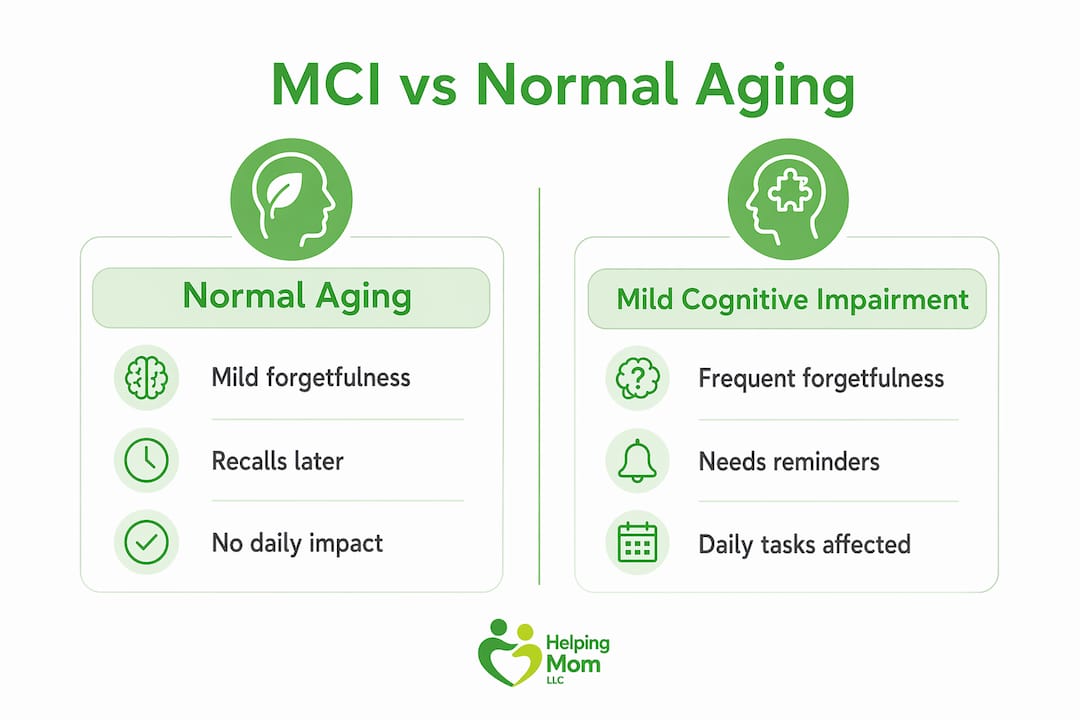
Normal aging involves mild, gradual changes that do not interfere with daily life. Your parent might take a moment longer to recall a name, or need to read instructions twice. That is different from MCI, which involves measurable deficits that show up consistently and can be detected through cognitive testing.
| Situation | Normal aging | MCI |
|---|---|---|
| Forgetting a name | Recalls it later without help | Needs repeated reminders or never recalls |
| Misplacing items | Retraces steps and finds them | Leaves items in illogical places regularly |
| Following a recipe | Completes it with no issue | Gets confused mid-task or skips steps |
| Managing appointments | Keeps track independently | Misses appointments or double-books frequently |
| Daily independence | Fully maintained | Maintained, but with more effort or errors |
The boundary between MCI and dementia comes down to independence. MCI is defined by cognitive changes that do not yet interfere with managing finances, medications, or daily appointments. When those core tasks start to slip, that is when the conversation with a doctor becomes more urgent.
One nuance worth knowing: people with neurodegenerative MCI often have less awareness of their own memory problems. If your parent is dismissing concerns entirely and showing no frustration with their own lapses, that pattern is worth noting for their doctor. It does not mean they are in denial. It may reflect how the condition is affecting their self-perception.
Pro Tip: Rapid or sudden cognitive decline should never be ignored. It may signal a urinary tract infection, medication reaction, dehydration, stroke, or another medical condition that needs prompt evaluation. Don't wait and see — seek medical attention quickly.
Understanding what MCI might mean for your parent's future helps you plan without panic. The picture is more hopeful than many caregivers expect.
MCI converts to dementia at a rate of approximately 10–15% per year, but progression is not inevitable. Many people with MCI remain stable for years. Some improve significantly when an underlying cause is identified and treated.
| Outcome | What it means for caregivers |
|---|---|
| Progression to dementia | Occurs in roughly 10–15% of MCI cases per year; early planning helps |
| Stable MCI | Symptoms plateau and do not worsen; regular monitoring remains important |
| Improvement | Possible when reversible causes are treated; medical workup is worthwhile |
About 15–20% of people diagnosed with MCI may return to normal cognition after treating reversible causes. Vitamin B12 deficiency, thyroid dysfunction, and poor sleep are all conditions that can look like MCI but respond well to treatment. This is why a thorough medical evaluation matters so much at the start.
A standard workup for suspected MCI includes blood tests like a complete blood count, metabolic panel, TSH, and vitamin B12 levels to rule out treatable contributors. Medication review is equally important. Several common medications, including anticholinergics and benzodiazepines, can mimic or worsen cognitive symptoms in older adults. Over-the-counter sleep aids and medications containing diphenhydramine (Benadryl) can also affect memory in older adults. Bringing a complete medication list to every doctor's appointment is one of the most practical things you can do as a caregiver.
Mood symptoms also carry weight as a prognostic signal. Apathy and irritability that appear before or alongside memory changes may indicate a more active process. Tracking these shifts over time gives doctors a clearer picture of what is happening and how quickly.
Supporting a parent with early cognitive changes is less about taking over and more about walking alongside them. The goal is to preserve their independence while quietly reducing the risks that come with memory and reasoning changes.
Here are practical steps that make a real difference:
Document what you observe.
Write down specific examples with dates. Note whether symptoms are getting more frequent or more severe. This record becomes valuable at medical appointments and helps track change over time.
Request a cognitive function assessment.
Ask the primary care doctor about formal cognitive screening. Tools like the Montreal Cognitive Assessment (MoCA) give clinicians a measurable baseline to compare against over time.
Review medications together.
Bring a full list of every medication, supplement, and over-the-counter product your parent takes. Ask the doctor whether any of them could be contributing to cognitive symptoms.
Make the home safer without making it feel clinical.
Small changes reduce risk without signaling a loss of independence. Good lighting in hallways, a weekly pill organizer, a whiteboard calendar in the kitchen, and labeled cabinet doors all help without feeling intrusive. As a Senior Home Safety Specialist, I've found that small environmental changes often make a bigger difference than families expect. Helping-mom's home safety for seniors guide walks through these adjustments in practical detail.
Build in gentle routines.
Consistent daily rhythms reduce the mental load of decision-making. Regular mealtimes, a predictable morning routine, and a set time for medications all support cognitive function without requiring your parent to rely on memory alone.
Support emotional wellbeing.
Apathy and anxiety are symptoms, not attitudes. Gentle encouragement to stay socially connected, whether through a weekly phone call with a friend or a regular outing, supports mood and cognitive health together.
Start important conversations while your parent can fully participate in making decisions.
MCI is a good time to discuss preferences around future care, finances, and legal documents like a power of attorney. These conversations are far easier now than they will be later. Helping-mom's guide to family meetings offers a calm framework for starting those discussions.
You do not need to have all the answers right now. Taking one step at a time, starting with a doctor's appointment and a written record of what you have noticed, is enough to begin.
While MCI usually develops gradually, certain symptoms require immediate medical attention. Seek urgent medical care if your parent experiences:
Important: These symptoms may indicate a stroke, infection, medication reaction, or another medical emergency. Don't wait — call 911 or go to the emergency room.
Early recognition of MCI symptoms, combined with a thorough medical evaluation, gives families the best chance to slow progression and preserve independence.
| Point | Details |
|---|---|
| MCI is distinct from normal aging | Symptoms are measurable and consistent, not occasional lapses that resolve on their own. |
| Independence is the key boundary | MCI preserves daily function; when core tasks slip, seek prompt medical evaluation. |
| Mood changes appear early | Apathy and irritability often precede memory symptoms and deserve attention. |
| Reversal is possible | Treating causes like B12 deficiency or thyroid issues can restore cognition in some cases. |
| Caregivers play a central role | Documenting symptoms, reviewing medications, and adjusting the home environment all support better outcomes. |
I've seen a lot of families arrive at this moment feeling like they missed something. They replay conversations from months earlier and wonder if they should have caught the signs sooner. One thing I've observed is that most people do notice something. They just don't know what to do with that feeling.
The families who handle this stage best are not the ones who act fastest. They are the ones who stay calm, observe carefully, and bring specific examples to a doctor rather than vague worries. A parent who forgets where they put their keys is easy to dismiss. A parent who puts their keys in the freezer three times in a month is a pattern worth documenting.
The other thing I've noticed is that caregivers often underestimate how much their parent already knows something is different. Many people with early MCI are quietly frightened and relieved when someone finally names what they have been experiencing. That conversation, done gently and without alarm, can actually strengthen trust rather than damage it.
The difference between normal aging and dementia is not always obvious, and you are not expected to diagnose anything. Your job isn't to diagnose your parent. It's to notice patterns, offer support, and help connect them with appropriate medical care. That is a meaningful role, and often one of the greatest gifts you can give.
— Mike
Helping-mom offers calm, practical guidance for adult children who are figuring out how to support a parent with memory or thinking changes. If you are at the stage of adjusting your parent's home to reduce risk while preserving their independence, the aging in place home safety guide covers the most common adjustments families make at this stage. For a room-by-room review of potential hazards, the elderly home safety checklist gives you a clear starting point. These resources are written for real families, not medical professionals, and they focus on practical steps you can take this week.
You don't have to figure this out alone. Explore our library of practical, calm guides designed for adult children supporting aging parents.