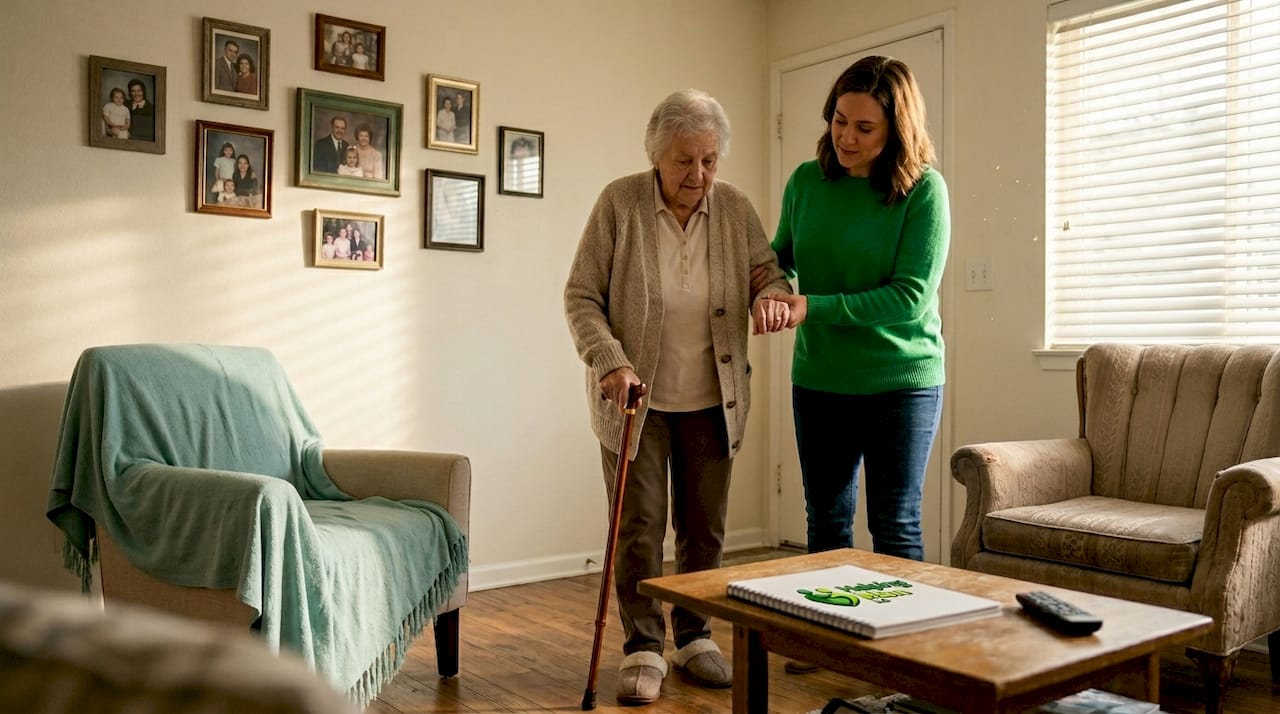
Most families hear "home care" and think nurses, medications, and medical equipment. So they wait.
They wait until something happens — a fall, a missed meal, a moment that feels off.
But most of what aging parents need every day isn't medical at all. It's help with the normal parts of life — getting dressed, making meals, keeping the home safe, and not feeling alone.
This guide walks you through what non-medical home care actually is, when it helps, and how to use it to support your parent without taking away their independence.
Non-medical home care covers everyday living needs that help aging parents remain independent and safe.
Non-medical support focuses on tasks and companionship, while home health care is clinical and skilled.
Evaluating your parent's needs and creating a clear care plan delivers practical, tailored support.
Using non-medical care eases stress for families and supports parents' well-being beyond just health.
Non-medical home care is a category of support that often gets overshadowed by conversations about doctors, prescriptions, and hospital visits. Yet for many aging adults, it's the type of help that makes the biggest difference day to day.
At its core, non-medical home care is supportive care delivered in a person's home that focuses on daily living and practical needs rather than clinical or skilled medical treatment. Think of it as the layer of support that keeps life running smoothly — including keeping a home safe and running safely — not the layer that manages a diagnosis.
Help with bathing, grooming, dressing, and toileting
Planning and cooking nutritious meals, accommodating dietary preferences
Laundry, vacuuming, dishes, and tidying common areas
Conversation, shared activities, and emotional presence
Rides to appointments, errands, or social outings
Prompting your parent to take their medications on time (not administering them)
"Aging in place" isn't just about having a safe home. It's about having the right daily support so your parent can continue living on their own terms.
With the basics defined, let's explore what non-medical home care providers actually do for your aging parent, and why these services matter so much for the whole family.
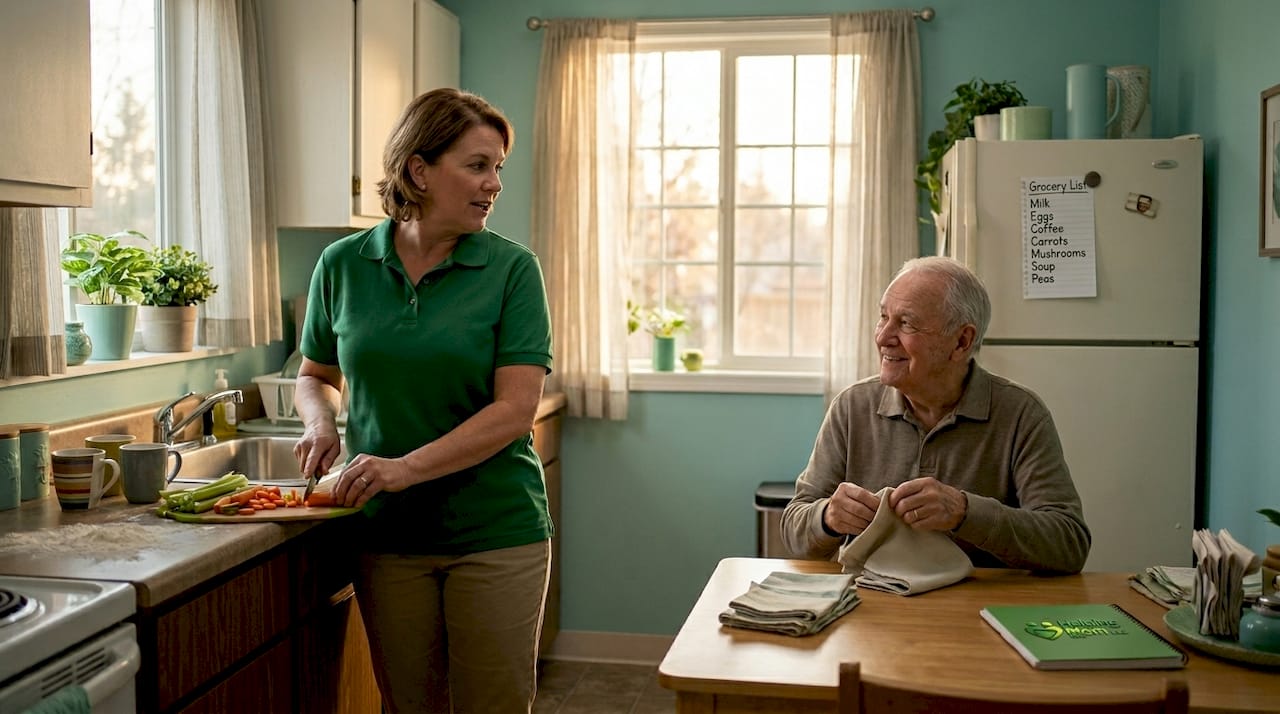
Non-medical home care services are typically organized around two categories: Activities of Daily Living (ADLs) and Instrumental Activities of Daily Living (IADLs). These are clinical terms, but the ideas behind them are straightforward.
Basic self-care tasks your parent needs to do every day:
Slightly more complex tasks that support independent living:
| Service | What it addresses | Family benefit |
|---|---|---|
|
|
Hygiene, dignity, fall risk | Reduces daily burden on family |
|
|
Nutrition, energy, independence | Ensures consistent, healthy eating |
|
Companionship
|
Loneliness, mental health | Reduces isolation without family visits |
|
|
Access to care, social connection | Maintains independence and routine |
|
|
Safety, cleanliness, organization | Prevents hazards and supports comfort |
|
|
Adherence to prescribed routines | Supports health without clinical oversight |
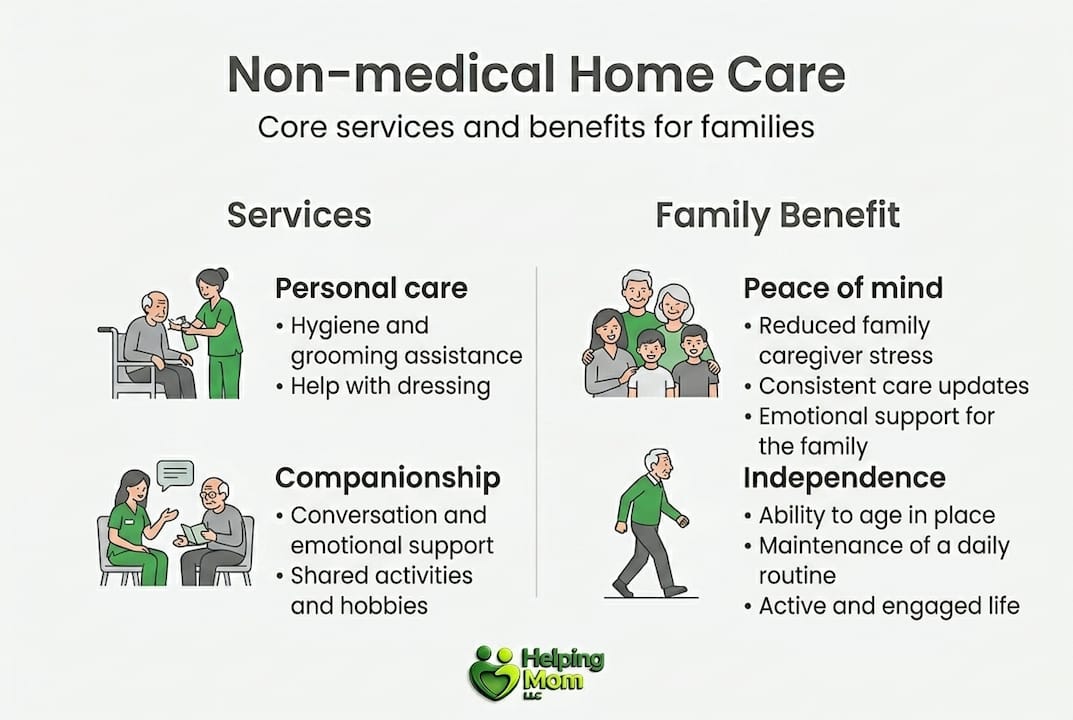
Understanding service types is useful, but it helps to see how non-medical care differs from skilled home health.
Here's why this matters: Many families use these terms interchangeably, and that confusion can lead to getting the wrong type of support, or feeling frustrated when one type doesn't cover what the other provides.
When your parent needs consistent daily support with personal care, household tasks, or companionship, and there is no active medical treatment requiring a licensed clinician.
When your parent is recovering from a procedure, managing a complex medical condition, or needs skilled clinical services like wound care or occupational therapy.
Non-medical home care can be thought of as the "human services" layer that supports aging in place: everyday functioning, routines, safety, and companionship, often delivered alongside, but not replacing, skilled medical home health when that level is needed.
Once you know the difference, the next step is to figure out exactly what support your parent needs and how to provide it. This is where many families feel stuck. The needs can feel vague or hard to pin down, especially when your parent is reluctant to ask for help.
A structured approach makes this much easier.
Here's what matters most:
Spend time in your parent's home and pay attention to what you notice. Is the refrigerator stocked? Are dishes piling up? Does your parent seem unsteady on their feet? Are they wearing the same clothes several days in a row? These observations are your starting point.
Be concrete. Instead of "Mom needs help around the house," write "Mom needs help with laundry twice a week, grocery shopping on Thursdays, and bathing assistance three mornings a week."
Decide who will handle each task: a family member, a paid caregiver, or a combination. A practical methodology for choosing and managing non-medical home care is to translate needs into structured tasks via assessment and care planning, specifying who will do what, how often, and toward what goal.
A simple written plan prevents misunderstandings and ensures everyone is on the same page. Include the task, the person responsible, the frequency, and any specific notes about your parent's preferences.
Your parent's needs will change. Build in time every few months to revisit the plan and adjust it. What worked six months ago may not be enough today.
With practical steps in mind, here's what most guides miss about the real-world impact of non-medical home care.
Most families don't start thinking about non-medical home care until something goes wrong.
A fall. A missed appointment. A phone call where your parent sounds confused or exhausted.
But the reality is this: the small daily things — meals, hygiene, movement, routine — are what quietly determine whether your parent stays safe and independent.
When those start slipping, it doesn't always look urgent. Until suddenly, it is.
Non-medical home care isn't just about getting chores done. It's about your parent being able to start the day feeling clean, well-fed, and cared for. It's about having someone to talk to on a Tuesday afternoon. It's about safety that doesn't require giving up independence.
Using a parent care checklist early, before a crisis hits, gives your family a clearer picture of where support is needed and helps you act from a place of calm planning rather than reactive stress.
Ready to put a plan into action for your family? The good news is you don't have to figure this out alone, and you don't have to do everything at once.
If you're not sure where to start, keep it simple.
Start by walking through your parent's home and noticing what feels harder than it used to.
Then use our elderly home safety checklist to spot easy fixes.
From there, the aging in place checklist helps you turn what you're seeing into a clear, manageable plan.
You don't have to solve everything today. You just need a place to begin.
Comprehensive guides and tools for supporting aging parents at home
Practical steps to create a safe environment for your aging parent
A practical guide to navigating the changing needs of aging parents
Expert guidance on home safety modifications and fall prevention
Start with our free resources today and create a personalized care plan that works for your family.