Discover the types of caregiver support your family needs. Learn practical options to ease your balancing act and provide the best care.

Family caregiver assisting elderly mother at kitchen table
You're managing your own life and quietly stepping into a new role at the same time.
It often doesn't feel like a clear transition. It just starts happening. More calls. More decisions. More moments where you realize you're the one figuring things out.
That weight builds slowly, and most people don't realize how much they're carrying until they're already tired.
If you're reading this, there's a good chance you're already carrying a lot and trying to make thoughtful choices without a clear roadmap.
The good news is you don't have to figure this out alone. There are practical, real-world forms of caregiver support that can take pressure off, create breathing room, and help you stay steadier while you help your parent.
This isn't about doing more. It's about not doing it all by yourself.
Combining information, emotional support, and practical help builds resilience for caregivers.
Regular breaks prevent burnout and keep family caregivers healthier.
Government and nonprofit programs offer a wide range of solutions for different needs and budgets.
Support groups and counseling can ease the mental and emotional strain of caregiving.
Identifying what matters most makes choosing support options simpler and more effective.
Most families don't need everything at once. They need the right next layer.
A simple way to think about it:
If you're unsure what to do → you need
information and guidance
If you're overwhelmed → you need emotional
support or relief
If you're stretched too thin → you need practical
help
You don't have to solve the whole system today. You're just choosing your next step.
If you're not sure where to begin, start here:
👉 /start-here
This is where most people begin—and where many stay longer than they should, simply because it feels familiar and less vulnerable than asking for hands-on help.
Information helps you understand what's happening and what your options are. It gives you language for conversations and helps you feel less uncertain.
But information alone doesn't carry the weight. At some point, you need support that actually changes your day-to-day experience, not just how much you know.
The National Family Caregiver Support Program (NFCSP) is a federally funded program that provides five core services to family caregivers. Information and assistance is the front door to all of them.
| Service type | What it provides | Time investment | Cost |
|---|---|---|---|
| Information and referral hotlines | Local resource lists, eligibility guidance | Low (one call) | Usually free |
| Area Agency on Aging | Personalized case coordination | Low to moderate | Free or sliding scale |
| Online resource directories | Self-guided research | Varies | Free |
| Social worker consultation | Detailed care planning | Moderate | Varies |
This is the layer many caregivers skip—and later wish they hadn't, especially when the stress and emotions start catching up.
You're making emotional decisions, often in real time, with someone you love. Having a place to process that, even occasionally, makes a difference.
Support here doesn't mean something is wrong. It means you're doing something hard and choosing not to do it in isolation.
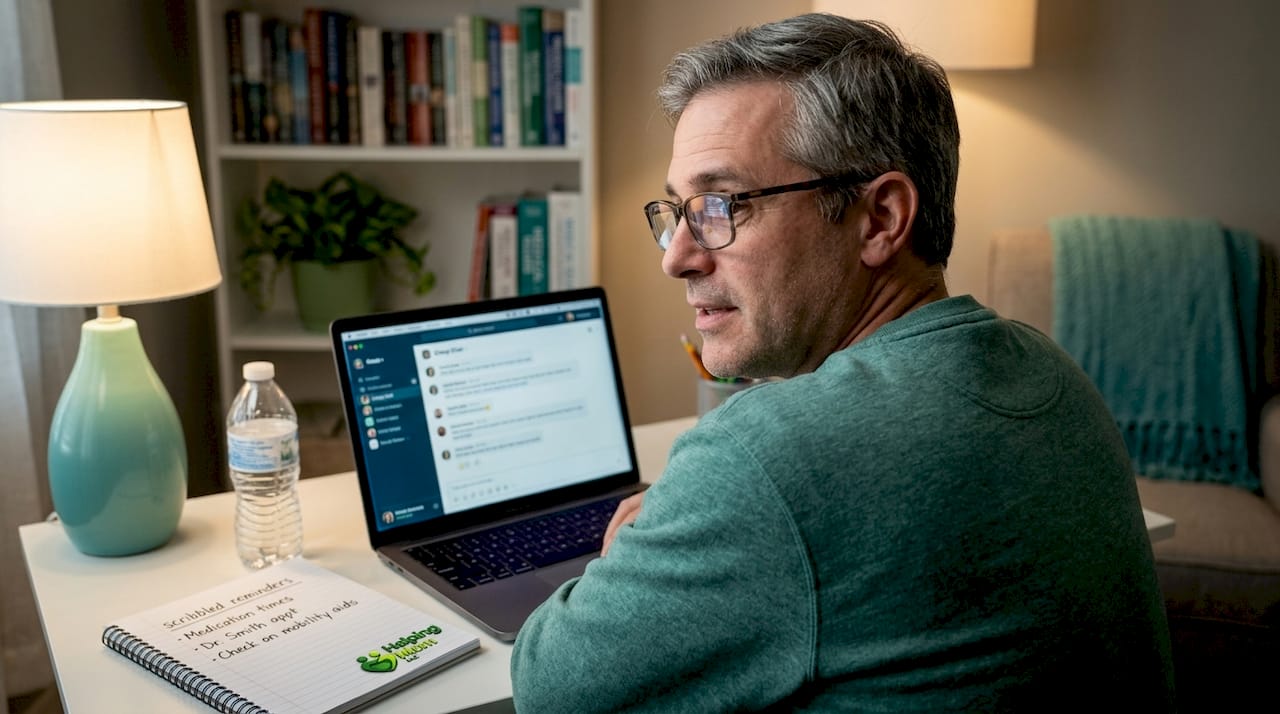
Counseling gives you a private space to process the complicated feelings that come with caregiving. Grief, guilt, frustration, and love often exist side by side in this role. A counselor who understands caregiver dynamics can help you work through those emotions without judgment and give you practical tools to stay grounded.
Support groups do something different. They connect you with other people who are living the same experience. That sense of "I'm not the only one" is powerful. It reduces isolation, normalizes the hard parts, and often surfaces practical ideas you wouldn't have found on your own.
Caregiver training is the practical piece. It might cover how to safely help someone move from a bed to a chair, how to manage medication schedules, how to recognize signs of decline, or how to communicate with medical providers. This kind of knowledge builds real confidence.
The NFCSP supported over 100,000 caregivers through counseling, support, and training services, with measurable results including reduced depression and anxiety and delayed nursing home placement for the people they care for. Those outcomes matter not just for your parent, but for you.
"Caregiving is one of the most meaningful things you can do. It's also one of the hardest. Finding people who understand that, whether a counselor or a support group, can change everything about how you carry it."
Pro Tip: You don't need to commit to ongoing therapy or weekly meetings to benefit. Even one session with a counselor or one support group meeting can give you a new perspective and a sense that you're not navigating this alone.
Respite care isn't a luxury. It's often the thing that keeps you going.
Even a few hours can reset your energy and patience. Without breaks, caregiving slowly becomes heavier than it needs to be, even when nothing specific has changed.
If this idea feels uncomfortable, that's normal. Many people hesitate the first time. But stepping away briefly is often what allows you to show up better, with more patience and perspective, when you return.
A trained caregiver comes to your parent's home for a few
hours or a full day, allowing you to run errands, rest, or
simply have uninterrupted time. This is often the easiest
option to arrange and the most comfortable for your parent.
Your parent attends a structured program during daytime hours,
often including social activities, light exercise, and meals.
These programs are excellent for parents who benefit from
social engagement and routine.
Your parent stays in a care facility for a few days to a week
while you travel, recover from an illness, or simply take a
longer break. This option requires more planning but provides
meaningful relief.
Some programs offer short-notice coverage for situations where
the primary caregiver has an unexpected need, like a medical
issue or a family emergency.
The scale of this need is significant. The NFCSP provided 6 million hours of respite care to over 600,000 families, which reflects just how many caregivers rely on this kind of relief to keep going.
These supports reduce the invisible workload you've probably been carrying without naming it.
Transportation, meal services, home modifications, and financial assistance programs don't just solve problems—they remove decisions and pressure from your day.
Small supports add up quickly. Taken together, they can change how your days actually feel.
If you're navigating resistance or hesitation from your parent,
this guide can help:
👉 /what-to-do-when-aging-parents-refuse-help
Programs like Meals on Wheels help ensure your parent gets
nutritious food without requiring you to cook daily.
For medical appointments, grocery shopping, or social activities.
For tasks like laundry, cleaning, and yard work.
Such as grab bars, ramps, or improved lighting to reduce fall risk.
Like shower chairs, walkers, or hospital beds.
So your parent can call for help if they fall or feel unwell.
The NFCSP funds supplemental services beyond basic care, including home modifications and transportation, specifically to help families maintain independence at home longer.
| Supplemental service | Best for | Impact on caregiver | Typical cost |
|---|---|---|---|
| Home-delivered meals | Parents with limited mobility | Reduces daily cooking burden | Low to free |
| Transportation | Parents who can't drive safely | Frees up caregiver time | Low to moderate |
| Home modifications | Fall prevention, mobility challenges | Reduces safety monitoring stress | Varies, grants available |
| Personal emergency response | Parents living alone | Reduces caregiver anxiety | Monthly subscription |
| Chore assistance | Maintaining a clean, safe home | Reduces physical labor for caregiver | Low to moderate |
Most caregiving systems work best when they include three things:
What's happening and what to do
Time, space, or shared responsibility
Emotional or practical
If one of those is missing, the whole system feels heavier.
You don't need perfect coverage. You just need enough support in each area to stay steady.
With the main support types detailed, here's a side-by-side view to help you see which combination could work for your family's unique needs. Most families end up using more than one type, and that's exactly the point.
| Support type | What it covers | Best for | Key benefit |
|---|---|---|---|
| Information and assistance | Resource navigation, referrals | Families just starting out | Saves time, reduces confusion |
| Counseling and support groups | Emotional processing, peer connection | Caregivers feeling isolated or burned out | Mental health, resilience |
| Caregiver training | Hands-on skills, medical knowledge | Caregivers managing complex daily care | Confidence, safety |
| Respite care | Short-term relief, scheduled breaks | Primary caregivers with no backup | Rest, sustainability |
| Supplemental services | Meals, transport, home modifications | Families managing practical daily gaps | Independence, reduced burden |
The families who tend to do best are those who treat caregiving support the same way they'd treat any other resource: they use what they need, ask for more when things change, and don't wait until they're in crisis to reach out.
You don't have to use every option at once. You're allowed to adjust the mix of support as your parent's needs—and your own capacity—change over time.
Most caregivers lean on information first. It feels productive, safe, and less vulnerable than asking for direct help.
But the support that actually changes things is usually:
That shift is what turns caregiving from something overwhelming into something more sustainable.
You're not failing if you need more help. You're adjusting to the reality that one person was never meant to hold all of this alone.
If you're trying to navigate conversations about change, this
may help:
👉 /how-to-talk-to-aging-parents-about-safety
You don't need to map everything out today.
Just choose one small step that makes things easier this week.
If you want a calm starting point, begin here:
👉 /start-hereOr use a simple structure to organize your next conversation:
👉 /family-meeting-agenda-templateYou're doing important work, and you deserve support too—without having to wait until you're in crisis.
Learn the essential steps to support your aging parents with compassion and practical care strategies.
Everything you need to know about helping your parents age comfortably at home.
Comprehensive resources to help seniors live safely and comfortably at home.
Effective strategies to manage and reduce stress while caregiving.
Easing end-of-life care for families through hospice caregiver support.