Caregiving Guide

How to Get Siblings to Help with an Aging Parent Without Creating Family Conflict

May 30, 2026 10 min read Mike
Siblings discussing caregiving plan in living room

Many adult children quietly become the default caregiver without ever intending to. Over time, doctor's appointments, phone calls, paperwork, and emergencies begin landing on one person's shoulders while siblings remain on the sidelines. If that sounds familiar, you're not alone.

Coordinating sibling support for an aging parent is one of the most common and emotionally charged challenges adult children face. The most effective approach is not to ask for vague help but to build a visible, documented caregiving system with specific roles assigned to each sibling. When you make the full workload transparent and match tasks to each person's real-life constraints, cooperation becomes a practical conversation rather than an emotional standoff. This guide walks you through how to get siblings to help with an aging parent using structured role assignment, family meetings, and mediation when needed.

How to Get Siblings to Help with an Aging Parent: Start with a Workload Inventory

Before you ask anyone for help, write down every caregiving task you currently handle. This single step does more to shift the conversation than any emotional appeal. When siblings can see a concrete list, they respond to facts rather than feelings, and defensiveness drops significantly.

A caregiving task inventory should include every recurring responsibility with its frequency and approximate time commitment. Think beyond the obvious. Common tasks include:

  • Picking up and managing prescriptions (weekly)
  • Scheduling and attending medical appointments (monthly or more)
  • Grocery shopping and meal preparation (multiple times per week)
  • Paying bills and managing finances (weekly)
  • Coordinating home maintenance and repairs (as needed)
  • Providing transportation to errands or social activities
  • Making daily check-in calls or visits
  • Researching care options, insurance, and benefits

Home safety responsibilities are often overlooked when families divide caregiving duties. Tasks such as checking smoke detectors, replacing trip hazards, reviewing lighting, updating emergency contacts, and arranging home modifications can become significant ongoing responsibilities. Including these items in your caregiving inventory creates a more accurate picture of the total workload.

Once you have this list, the conversation changes. You are no longer saying "I need help." You are saying "Here are 14 tasks that happen every week. I currently handle 11 of them. Let's talk about who takes which ones." That shift, from emotional plea to factual handoff, is what reduces tension and opens the door to real cooperation.

Pro Tip

Use a simple spreadsheet or even a handwritten table with three columns: task, frequency, and current owner. Bring this document to your first family meeting. Seeing the full picture in writing is often the moment siblings realize how much has been falling on one person.

How to Assign Caregiving Roles Based on Each Sibling's Real Situation

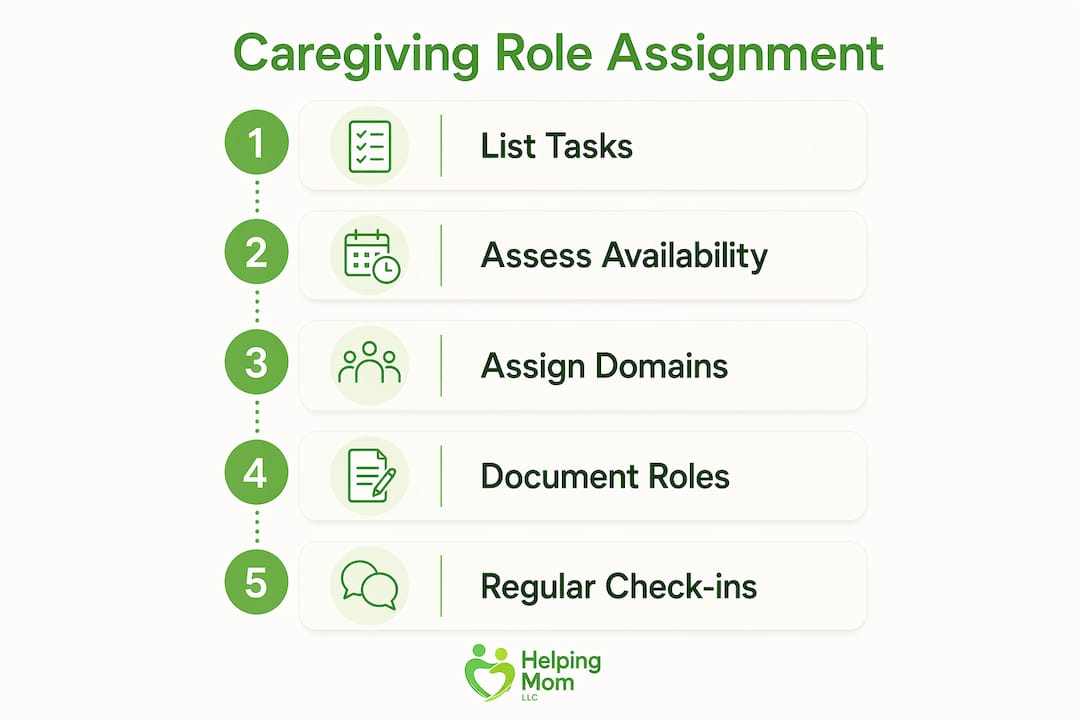
Once the workload is visible, the next step is matching tasks to people based on what each sibling can realistically do. Role-based division accounts for distance, work schedules, health, finances, and individual strengths. This approach leads to fairer, more sustainable cooperation than splitting tasks randomly or asking for favors on the fly.

Think in terms of care domains rather than individual tasks. The five main domains in elder care are:

  • Medical coordination: Managing appointments, communicating with doctors, tracking medications
  • Financial management: Paying bills, handling insurance, monitoring accounts
  • Home and physical support: Grocery runs, transportation, household maintenance
  • Emotional and social care: Regular visits, phone calls, companionship
  • Planning and research: Investigating care options, legal documents, community resources

Assigning a sibling ownership of a domain, rather than asking them to help with individual tasks, creates accountability. It also reduces the constant renegotiation that happens when caregiving is treated as a series of one-time favors.

Domain Best Suited For Example Tasks
Medical coordination Local sibling with flexible schedule Doctor visits, pharmacy pickups, health updates
Financial management Sibling with finance background or remote location Bill pay, insurance claims, benefit research
Home & physical support Local sibling or hired help Grocery shopping, transportation, home repairs
Emotional & social care Any sibling, including remote Daily calls, video chats, planning visits
Planning & research Organized sibling, any location Care facility research, legal document review
Infographic of caregiving role assignment steps

Siblings who live far away are not off the hook. Long-distance siblings contribute meaningfully through remote tasks like managing finances, handling insurance paperwork, and scheduling appointments by phone. Distance is a constraint, not an excuse.

Pro Tip

Write the role assignments down and share them with everyone. A simple one-page document listing each sibling's domain, specific responsibilities, and a named backup prevents the "I didn't know that was my job" conversation from happening six months later.

How to Run a Family Meeting That Actually Leads to Shared Caregiving

A family meeting focused on caregiving works best when it has a clear agenda and stays grounded in facts rather than old grievances. Structured family meetings with visible roles and regular communication check-ins prevent blame and create clarity. Without structure, these conversations drift into family history and nothing gets decided.

Here is a practical agenda for your first caregiving family meeting:

  1. 1 Share the current situation. Present your parent's health status, daily needs, and any upcoming decisions. Keep this factual and brief.
  2. 2 Walk through the workload inventory. Show the full task list with current owners. Let the numbers speak.
  3. 3 Propose role assignments. Offer a draft based on each sibling's constraints. Frame it as a starting point, not a final verdict.
  4. 4 Discuss and adjust. Give everyone space to raise concerns or propose swaps. Focus on what works, not who is doing more.
  5. 5 Agree on a shared tracking system. Decide how you will communicate updates, whether through a shared Google Calendar, a group text, or a caregiving app.
  6. 6 Set the next check-in date. Monthly or biweekly check-ins keep everyone aligned and allow adjustments as your parent's needs change.

A few communication practices that help these meetings stay productive:

  • Send the agenda at least 48 hours in advance so no one feels ambushed
  • Hold the meeting by video call if siblings are in different locations
  • Designate one person to take notes and share a summary afterward
  • Keep the focus on your parent's needs, not on who has done more in the past

You can use a family meeting agenda template to organize your first session and reduce the prep work. Having a ready-made structure removes one more barrier to getting started.

What to Do When Siblings Refuse to Help

Some siblings will not engage, no matter how clearly you present the workload or how reasonably you assign roles. This is painful, and it is more common than most families want to admit. The answer is not to keep asking in different ways. The answer is to change the structure of the request and, if needed, build a care plan that does not depend on their participation.

When a sibling is resistant, move from open-ended requests to specific, time-limited commitments. Instead of "Can you help more?" try "Can you take over the monthly insurance calls for the next three months?" Specific, time-limited asks convert emotional stalemates into operational decisions. They are harder to refuse because they are concrete and bounded.

If conflict is recurring or a power imbalance is making cooperation impossible, eldercare mediation is worth considering. Eldercare mediation involves a neutral third party who facilitates problem-solving and helps family members reach agreements, sometimes in writing. It works best when all parties genuinely want to maintain their relationships and are willing to find creative solutions. It is not a last resort. Many families use it proactively to prevent conflict from escalating.

If a sibling ultimately refuses to participate after clear, specific requests, build your care plan around reliable people and paid support. A sustainable care system does not depend on uncertain participation. Community resources, home health aides, and local senior services can fill real gaps. Your parent's care cannot wait for a sibling to come around.

Protecting your own well-being matters here too. Carrying resentment toward an absent sibling while managing a full caregiving load is a path to caregiver burnout. Set realistic expectations, document what you are doing, and get support for yourself as well as your parent.

Tools and Practices for Keeping Sibling Coordination on Track Over Time

Getting siblings to agree on roles is the beginning, not the end. Caregiving needs change, life circumstances shift, and what worked six months ago may not work today. Sustainable coordination requires regular review and shared visibility into what is actually happening.

Hand checking caregiving task spreadsheet

The most effective coordination systems share three features. First, every task has a named owner and a named backup. Assigning backups prevents any single sibling from becoming the default when someone is unavailable. Second, task completion is tracked somewhere everyone can see it. A shared Google Calendar, a group note in an app like Notion, or even a printed monthly checklist works. Third, the plan is reviewed on a set schedule, not just when something goes wrong.

Practice Why It Works Tool or Method
Named owner & backup per task Prevents default overload on one sibling Written role document, shared digitally
Shared task tracking Creates visibility and accountability Google Calendar, Notion, or a shared caregiving app
Monthly check-in meeting Catches problems before they become crises Video call with standing agenda
Written role agreements Reduces "I didn't know" conflicts Simple one-page document, emailed to all
Annual full review Adjusts for changing parent needs Scheduled family meeting, once per year

Documenting agreements and sharing updates regularly prevents burnout and miscommunication. The families who sustain cooperation over years are not the ones who had the easiest conversations. They are the ones who built a system and kept returning to it.

Pro Tip

Set a recurring calendar reminder for your monthly sibling check-in the moment you finish your first family meeting. If you wait until something goes wrong to schedule the next conversation, you will always be reacting instead of planning.

Free Download: Family Meeting Agenda Template

Use our Family Meeting Agenda Template to organize caregiving discussions, assign responsibilities, and keep everyone on the same page.

Download the Template

Key Takeaways

Effective sibling caregiving coordination requires a visible workload inventory, domain-based role assignments, and a structured communication system that adapts as your parent's needs change.

Start with a task inventory

List every caregiving task with frequency before asking anyone for help.

Assign domains, not just tasks

Give each sibling ownership of a care domain based on their real constraints.

Use structured family meetings

A clear agenda and shared tracking system prevent blame and build accountability.

Try mediation when needed

A neutral eldercare mediator can resolve recurring conflicts and produce written agreements.

Build a system, not a wish list

Sustainable care plans include backups, written agreements, and regular reviews.

What I've Learned About Getting Siblings on the Same Page

I want to be honest with you about something. The hardest part of coordinating sibling caregiving is rarely the logistics. It is the emotional weight of feeling like you are the only one who sees what needs to be done. That feeling is real, and it is exhausting.

What I have found, working with families navigating this, is that most siblings are not indifferent. They are overwhelmed, uncertain, or simply unaware of how much is happening. When you show them the full picture in writing, something shifts. Not always immediately, but it shifts. The conversation moves from "why aren't you helping?" to "here is what needs to happen and here is where you fit." In many families, the sibling doing the most caregiving often assumes everyone else knows how much work is involved. In reality, many siblings only see the occasional appointment or crisis and never see the dozens of small tasks happening behind the scenes.

Role assignment is not about fairness in the abstract. It is about matching real people to real tasks in a way that holds up over time. A sibling who travels for work every week cannot reliably handle weekly grocery runs. But they can own the insurance paperwork and the monthly financial review. That is a meaningful contribution, and naming it as such matters.

If you are the one carrying most of the load right now, please do not wait for a crisis to call a family meeting. Schedule it now, bring your task list, and start the conversation from a place of information rather than frustration. And if you need support along the way, resources on caregiver well-being are there for you too. You cannot pour from an empty cup, and taking care of yourself is part of taking care of your parent.

— Mike

Smiling man with white hair and glasses wearing a purple checkered shirt outdoors in front of a garden

Reviewed & Edited by Mike

Certified Home Safety Specialist | Age Safe® America

View Credentials

How Helping Mom Supports Families Coordinating Care

At Helping Mom, we know that coordinating care for an aging parent is rarely a one-time conversation. It is an ongoing process that requires practical tools, clear communication, and a plan that grows with your parent's needs. Our resource hub includes a family meeting agenda template to help you structure your first sibling conversation, along with guides on how to coordinate care for an aging parent as a family. When you are ready to think about the home environment, our practical home safety guide walks you through the changes that make aging in place safer and more sustainable for everyone involved.

Frequently Asked Questions

How do I start the conversation with siblings about caregiving?

What if one sibling lives far away and can't help in person?

What is eldercare mediation and when should I use it?

How often should siblings check in about caregiving responsibilities?

What do I do if a sibling simply refuses to help?

Recommended Reading